February 14-20: Random Kindness Week
 In the February chapter on love, Gretchen Rubin has a section entitled, “Give Proofs of Love,” in which she quotes Pierre Reverdy, who said, “There is no love; there are only proofs of love.” This reinforces the idea that love is an action verb, not a feeling.
Again, she inserts research that claims that hugging relieves stress and that 47% of those surveyed felt closer to family members who expressed affection.
I also took to heart her point that “if you want to know how people would like to be treated, it’s more helpful to look at how they themselves act that what they say.” In other words, if someone who never misses a birthday and who always gives thoughtful, personal gifts says, “Oh, I don’t need anything for my birthday,” don’t take that seriously. This may be the other side to my observation that we tend to give people what we want to receive. (I scratch your back where mine itches, hoping you’ll get the hint and scratch me there.)
Probably the most important point she makes, one I could use, is to do something nice not in order to get credit or gratitude: “Do it for myself.”
Directly and indirectly today, I’ve been reminded that this is “Random Acts of Kindness Week.” I heard accounts of other people on the receiving end, and then the woman in front of my in the drug store (where I was loading up on cough medicine) asked the clerk to pass her $10 credit on to the next customer (me!) Without giving too much away, I’ll tell you that I was part of a group last year doing some secret acts of kindness this time last year, swearing each other to secrecy. The results were so much fun, we found another opportunity to act on an even bigger scale at a time when the people around us needed a boost. Hearing the response and the guesses about the source of the surprises was much more fun than credit or recognition.
Try it for yourself–and mum’s the word!
February: Learning to Fight Right
When I first saw the title of this section about fighting right, I was tempted to skip right over it. I tend to avoid conflict, yet I’m suspicious of people, particularly married couples, who claim they never fight. My own grandmother loved to boast that she and my grandfather never had a fight. I suspected that sometimes she just didn’t listen.
As I read, though, I found several interesting points to consider. One thing I enjoy about the book is the way Gretchen Rubin uses research, rather than simply relying on her own hunches or personal experience. In one of my favorite funny novels, The Rosie Project by Graeme Simsion, the protagonist relies so much on rationality that he even approaches finding a mate by using research. In this part of the February chapter, I learned the following tidbits based on research:
(1. “Couples who fight right tackle one difficult topic at at time.” Sure enough, as tempers flare, it’s easy to bring up tangential irritations instead of focusing on solving the problem at hand. It’s rarely productive.
(2. “It takes at least five positive. . . actions to offset one critical or destructive action.” The simple math then suggests that it pays to focus intentionally on producing positive action.
(3. Women perceive face-to-face interaction as more intimate; men prefer side-by-side. Awareness of this difference might just make it easier to interpret situations. I’ve always suspected that we tend to give what we want for ourselves. If my back itches in one particular spot, that’s where I scratch his back. If I prefer chocolate for Valentine’s Day, that’s what I get him. When I was in elementary school, I always gave my family writing utensils for Christmas gifts, not just because the only shopping I could do when they weren’t watching took place at the school bookstore, but because I liked cools pens for myself.
(4. “[T]he most reliable predictor of not being lonely is the amount of contact with women.” This, she suggests, is true for both men and women.
Some of my takeaways from this section include adherence to Rubin’s Ninth Commandment to “lighten up.” I also share her “particular bosom enemy: snapping.” Sarcasm, clever but hurtful repartee, comes easily but can cause lasting damage. I learned years ago not to say those barbs that pop so easily to the tip of my tongue, but I still slip up and blurt. Often it is in my own best interest to shut the bathroom door, say them to the mirror, and then let it go.
With moving day coming up soon, I will make a resolution to focus on the positive as we survive the second half of the moving experience. If we can come out of that experience amicably, not just civilly, we’ll certainly up our happiness quotient.
The Only Person I Can Change is Myself
 I’m intentionally moving slowly through the February Chapter: “Remember Love: Marriage.” Even though Gretchen focuses on her marriage relationship primarily in the chapter, the principles apply in all close relationships, particularly family, where we tend to expect more of one another.
That old axiom “Familiarity breeds contempt” may overstate the problem, but I know that it’s not unusual to speak hasty, unkind words to those closest to us we would never think of saying to strangers or acquaintances. We treat worst the people we love most.
Again, Rubin isn’t playing marriage counselor or handing out one-size-fits-all prescriptions; instead, she focuses on some of the points she’s already discovered. First, she acknowledges that she “couldn’t change anyone else.” She begins to pay attention to the little things that make a difference. One of the “Secrets of Adulthood” she repeats is that “What you do every day matters more than what you do once in a while.”
She may be right when citing experts’ research showing that the arrival of children can have a huge negative impact on a marriage, but having come through that challenge—successfully, I believe—I will point out that other life experiences pose their own challenges.
Moving, for example. All those studies that rank the effect of different stressors—death in the family, divorce, job loss—rightfully rank moving high on the list. I think moving is stressful even when it’s a conscious choice, as ours has been. We know we are getting closer to goals that will produce long-term happiness, especially since we’ll be closer to family.
In the meantime, however, we had to assess—even handle—everything we owned and decide whether to pack it to go, to throw it away, or give it away. Leaving it untouched was not an option. In our case, we had to accomplish this in a thirty-day period, during which we also had to find and buy a new home in a city six hours away. We had more to do than we could possibly do. But we did it. There was no “assigning tasks,” but whoever could do something did it.
Some tasks fell to me because no one else could have known what needed to be done. Since my husband was continuing to work through the whole moving experience, much of which he did by phone or Internet, I had more of the moving responsibilities. On the other hand, he had to work out the logistics of buying and selling, dealing with realtors, bankers, and movers—all tasks that give me the willies.
While we’re waiting for closing, most of our possessions are waiting on a moving van, while we live out of our cars, where we’ve packed what we hope will be enough clothes and necessities for a couple of weeks. We’ve spent much more “together time”—and because we both recognize the stress we’ve experienced, I hear him say, “Please” and “Thank you” frequently. He may have always said them, but they certainly mean a lot now.
A final point I’ve noted from the first part of the February chapter is that I, too, tend to want credit (or gold stars) for doing what I do. A book I highly recommend is Personality Plus by Florence Littauer. In it, she uses the four humours from medieval philosophy to describe temperament. The book includes an excellent self-test that also proved a great vocabulary exercise when I used it in class. Rarely have I seen anyone read the description of his or her type without saying, “Yes! That’s me exactly!”
I’m a classic “Sanguine” personality. In the book, she not only helps readers to understand ourselves but to look at how we interact with other types—or sometimes just as challenging—with people just like us. I did discover that a group of sanguine types can get on one another’s nerves because we all want the attention.
I also learned that the way I am isn’t the “best type.” The world’s a better place, more interesting and efficient, when various temperaments interact, each finding his or her own best role.
I think I’ll do a little review this week. I saw my mother’s copy of the book on the shelf of the guest room where we are staying a few days, awaiting our closing. I might even convince myself to forego the gold stars and just love!
February: There Is Only Love
I am glad I set out from the beginning to approach this particular year of the Happiness Project not as a set of resolutions with a firm time line but as a way to make my good life even better. The contract on our house that popped up right after the year began threw everything in my life into a tailspin, but I tell you this: if you want to get a good look at the sum total of your life, move.
While I couldn’t possibly attack all the clutter, I did get rid of lots of “stuff.” In fact, my mantra became the line I read on Pinterest late one night (or early one morning): You are not a store. You don’t need to keep things just in case you might need them some day. If I’d had more lead time, I could have approach my own personal clutter more deliberately, but by the time the movers arrived and started throwing everything into boxes, I knew I had lost the skirmish, if not the war. Lots of decluttering will have to happen as I unpack.
Now that February begins to focus on love, though, I have a strong testimony. The very process of moving is tough on a family, but it also confirms enduring love. My grown children have all played a part–sometimes under duress–in helping to get their remaining detritus out of the house. My daughter and her family are putting us up (or putting up with us) until our house closes (in ten days). Spending all day with them–with our grandchildren–confirms our reason for moving here to be closer.
I’ve also had reaffirmed the strength of the friendships we are leaving behind. The goodbyes were spoken through lumps in our throats–or left unspoken. Already, we have friends making “reservations” in our guest room for March. I’ve been overwhelmed by phone calls, emails, Facebook comments from my North Carolina friends, as well as welcomes from those we are moving nearer.
When I packed my car with all those things I needed before the moving van returns with all our boxes, I made sure to include my Valentine plates, recipes, and craft materials. What fun to get to make Valentine candies, cookies, and cards with Avery, Stuart, and Griffin. This month will certainly invite a closer look at love.
January Tip for Monday: Look Elsewhere
I’ll confess that it’s almost midnight here, and I’ve finally sat down after packing all day (again) except for a few trips out (1. for more boxes; (2. to donate books, clothes, etc.; (3. for lunch with some friends I will miss.
But I’m keeping our book project in mind as I go. Today I have failed on the “getting more rest” suggestion, but I’m definitely thinking more and more about clutter.
I wanted to point out a couple of places to look online that can be either a total time suck or a life saver: One is Pinterest. Even though I don’t sit there for hours looking for recipes or cute dresses, I’ve found this site to be a great tool. First, whenever I find an online article I want to keep, I save it to Pinterest. I have the option of making up my own boards, so I have reading, teaching, art, music, and now MOVING boards.
Second, when I want to know how to do something, chances are, someone’s already figured it out–and posted it. I was pondering how to pack jewelry, and Bingo! I decided to look on Pinterest. I found several tips I will definitely use to simplify my life.
For example, you should take a digital photo of the back of electronics before disconnecting so you’ll know how to put it back. Since I figured out how to hook up our Bose wireless sound system to the television and other electronics, I don’t want to have to start over completely.
I didn’t have to print anything out (that I’d lose before I used it). It will be there as long as Pinterest is still around.
The other site I encourage you to explore as you are considering upping your happiness factor is Ted Talks. I found so many uses for these relatively brief inspirational talks when I was in the classroom, and there are so many different topics that it’s worth wandering around awhile to see what you might learn.
After all, you can’t spend all day on Facebook, can you? Go look around.
Snowed In: What’s a Girl to Do?
If I’ve learned anything during the moving process, it’s that doing a little all along is the key to most success. When I think of all I have to do before our movers arrive, I panic; when I do a little all along, it begins to seem doable. My biggest challenge is avoiding distraction. That’s one reason I packed books first. I’ll admit that I have one stack to the side in my “take with me; don’t send with the movers” pile.
The same principle applies to exercise, one area on which Rubin focuses in January. Even though I know that eating less is more important for weight loss than exercise, I believe in the multiple benefits of exercise, especially aerobic exercise of any kind. I’ve tried to tell myself that lifting boxes and climbing stairs is sufficient. I’ve heard other people say, “I don’t need to work out. Do you know how much I walk at work?” It’s not the same thing. Part of the benefit of walking, for me, either in the neighborhood or on the treadmill, is that time set aside when I just read or think or listen to music.
Even when I get tired to sweaty, I alway feel better after thirty minutes or an hour of exercise. As soon as the snow melts enough here to get out and about, I plan to go to the health club and get in a full hour–step machine, weights, and the bicycle. I drink more water when I work out intentionally. When I get home, I’m energized, and I think twice about eating empty calories once I know how many I’ve just burned and how quickly I could undo that benefit.
One tip I’ll add that works for me: It’s that old principle of accountability. I am more likely to get in my exercise if I have a workout partner. My friend Claudia and I have been walking together or going to the gym together for years. The walking has given us a chance to talk through raising our children or to discuss what we’re reading now or next. I hope when I get to Nashville, I’ll find someone like Claudia (ha! There is no one like Claudia) to keep me focused on being fit.
Monday: Kon-Hurry instead of Kon-Mari.
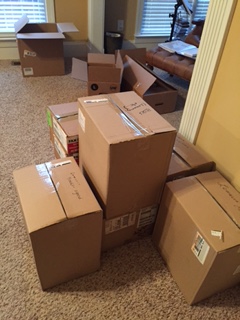
 When I proposed the year-long virtual Happiness Project Book Club, I didn’t know I’d be packing to move through January, but sure enough, we’ve sold our house, with a February 2 closing date. If all goes well, we will be closing on our new home in Nashville mid-February. With less than a month to buy a house and to pack, I’m in panic mode.
I should be good at packing; I’ve done it enough. Since I was a preacher’s kid, moving regularly was par for the course. Even in college, I moved from dorm to dorm, then room to room. Every time I’ve moved, especially in my adult life, I’ve said, “Never again!” referring (1. to moving and (2. to accumulating so much stuff. But I do it again and again.
So now the house is piling up with packing boxes, many full, some empty. I’m making the circuit of grocery stores and package store, begging for more boxes. After making my way through the halfway mark of The Life-Changing Magic of Tidying Up by Marie Kondo, I must admit to myself that there is no way I am going to be able to follow her steps, starting with all my clothing, touching every item, assessing it’s capacity for joy. Instead, I’m just doing my best to pack like with like. I’ve sorted my books first, since they account for most of the weight–physical and psychological. I’m working in my craft room now, a bigger challenge since nothing has a uniform shape. I went by U-Haul and got some wardrobe boxes.
I have an appointment at Adrienne’s, my favorite consignment store, to bring in some clothes for spring. I’m hoping (and praying) that some of the family members really will come with a truck or a van to help and to take some household items back to Henrietta’s Closet, a consignment sale my sister and friends have been running twice a year for a long, long time.
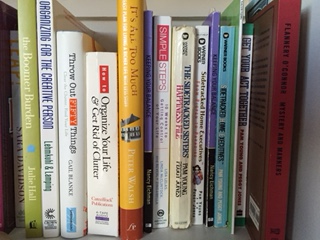
In the meantime, I had to come clean and share one particular spot on my bookshelf. Notice anything ironic? All those books on decluttering have brought as much success on my books on alchemy and my Powerball ticket purchases. Maybe once I get moved in and unpacked, I will read them!
Which aspect of January’s chapter do you find most challenging? Most needed?
By the way, when I asked you to introduce yourself, it’s find if you just say, “I’m ________ and I know Nancy from __________________. No need for added stress. This should just be fun.
Thursday–a Day Late
 One of the first points I noted in Chapter 1: January is that I am more likely to stick with resolutions (plans, goals–call them what you like) if (1. I make a commitment and (2. I establish accountability either by telling others what I am going to do, so I’ll be shamed if I quit or, even better, I enlist others to join me. Accountability is the trendy word, but it helps. In Bill Bryson’s delightfully funny, interesting, and entertaining book A Walk in the Woods, he says that once he decided to hike the Appalachian trail, he announced his intention in his Christmas cards so everyone would know and hold him to it. That’s why I wanted some of you to join me this year.
Of the three areas Rubin discusses in this chapter, this week it makes sense for me to focus on “Toss, Restore, Organize.” If you haven’t inferred from my Facebook posts, we have recently sold our house. The contract came four days after the first showing and the closing is set for thirty days after that. February Second. I don’t have time to sleep–and when I do, I dream either of packing boxes or of driving around looking for a house. My exercise plan right now has a lot to do with lifting heavy objects (boxes of books) and going up and down stairs.
I’ve always been fascinated with books about organizing the clutter. My fascination calls to mind the old poster (it would be a meme today): “I’m fascinated by work. I could sit and stare at it all day.” Ironically, I have at least one small boxful of books on organizing and learning the clutter. One covers two areas of this month’s focus: Does This Clutter Make My Butt Look Fat, in which author Peter Walsh contends that disorganization in one’s life has a strong connection to overeating and being overweight. I think I ate the book.
One of my favorites is the Sidetracked Sisters’ Happiness File. Unlike most books like this, it’s not written by people who are naturally organized, telling the rest of us what we’ve been doing wrong. These two sisters were so disorganized that the clutter was having a negative effect on their lives and their marriages. They used a 3 x 5 cards system that made a lot of sense, whether one adopted the whole thing or just adapted it to meet one’s needs.
I’m reading The Life Changing Magic of Tidying Up by Marie Kondo now, mainly thinking of how to take her unusual principle and apply it to my notebooks full of poems. I can’t imagine having the time or opportunity to take every article of clothing to one room, picking up each, piece by piece, and determining if it brings me joy. Confession: I have a Jerry Jeff Walker concert t-shirt from 1976. It doesn’t fit. It brings me joy.
Moving does teach me the only lesson of pseudo-physics I know: Stuff expands to fill up the available space. Whether I move often, as we did in the first years of our marriage, or every ten years, as we’ve done the last couple of moves, I have more stuff than I can even sort. The biggest physical quantity is composed of books. Imagine that. The second biggest is other nostalgic paper stuff: photographs, letters, old newspapers. I’ll probably summon the nerve to toss some of those magazines I’d love to go through again. I will keep the Oxford Americans (my answer to most folks’ stacks of National Geographic).
I don’t have time (or desire) to have a yard sale, although I have so much I’d like someone else to have. I have things I could sell if I had time to fool with it. I know that the closer we get to closing, the less I’ll worry about it. I’ll throw away, give away, beg others to come and take it away.
The big dilemma now, as well look for a house, is whether I should look for one with plenty of storage, knowing I’ll fill it up, or one with out much extra space, hoping I’ll improve my habits. Either way, I hope it’s the path that leads to more happiness.
It’s Monday. Who’s Getting Happy?
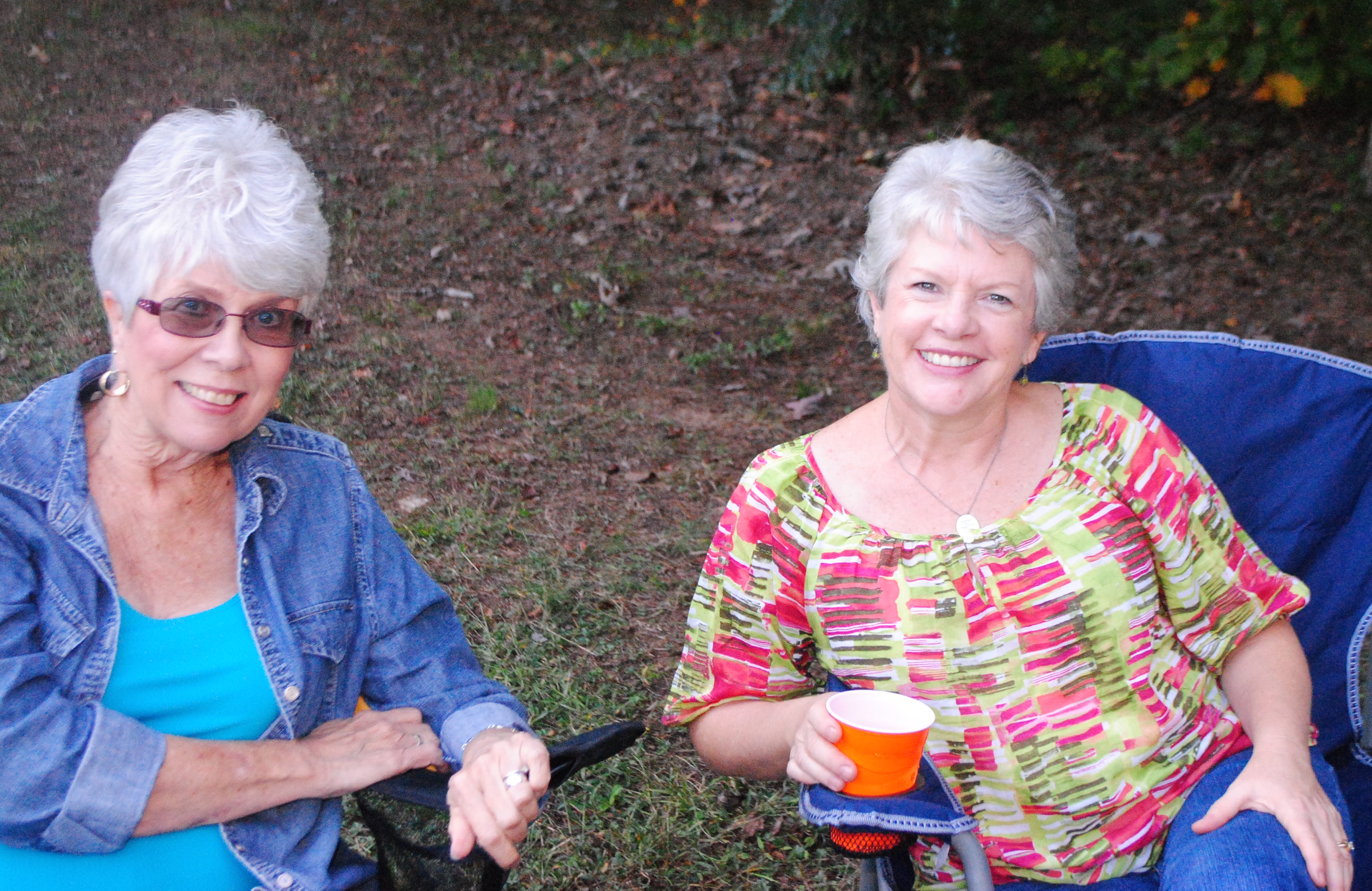 I’ve heard from lots of my friends who are joining our virtual book club. Today while you’re reading through January and thinking about how to boost energy, take a little time to log on and introduce yourself. (I’m adding a picture of me and my Cuz Sandy, who’s joining us here.)
I think most of you know me: Nancy Posey (one of the Coats girls). I’m living in Hickory, NC, for now, but we plan to move to Nashville, TN, if our house selling and buying ventures work out right. I love to read, but I enjoy books most when I have the chance to talk about them. I read Happiness Project last year when I was part of a group of colleagues last year trying to avoid negativity at work.
I’m a wife, mother, grandmother, daughter, sister, and friend. I’ve been a teacher for 25+ years. I write poetry, read voraciously, play the mandolin, and enjoy art and photograph projects. I’m a happy person. I just need to find ways to channel my energy so that I don’t just dabble at the things I like to do. I want to finish more things I start.
I’ve always been one to keep in touch with friends–long before Facebook. I’m looking forward to bringing together some of my favorite people and your friends to make the most of this year.
Getting Started in January
I’ve noticed that people are resistant to New Year’s Resolutions–or apologetic at best. Somehow we make up our minds that we won’t follow through, so what’s the use? I’ve found, though, that when I have projects to last a year, broken down into increments that are doable, I not only CAN follow through, but I feel so good when I do.
Last year, I read The Happiness Project for the first time all the way through, and even though I was sometimes tempted to read on into the next month, I didn’t. As I read, however, I always wished I had someone reading along with me. I enjoy any book more when I can talk about it. This one begs to be shared.
If you’re along for the ride this year, simply plan to enjoy it. As I suggested in the last post, get a notebook, a real one or a virtual one, and keep notes. I’m taking her “Twelve Commandments” and “Secrets of Adulthood” from the prologue and tweaking them as I go along.
Today, for example, at a morning meeting with some of my writing friends, we talked about how that sometimes we find we’re solving the wrong problem (See Commandment #7). Kelly suggested approaching problems as an engineer would. I think #1 should be “Be ________” with your name filled in. Happiness is not one-size-fits-all. Even as a teacher I learned that some of the teachers I admired had styles that would never work for me. How liberating that discovery turned out to be.
Under her “Secrets of Adulthood,” when she says, “Most decisions don’t required extensive research,” I thought of Occam’s Razor: The simplest solution is often the best one (or, as I heard it said, “When you hear hoofbeats, don’t look for zebras.”)
We need to remind ourselves, too, that happiness is not only a worthy goal, but it’s not such a selfish one. One thing she discovers through her year was that she was happier when the people she cared about were happy, and when she was happy, the people around her were more likely to be happy too.
Ch. 1: January: Boost Energy
After you read through the chapter, please share your tips for the following areas:
Getting enough sleep
Developing a regular exercise plan
Creating order (or eliminating as much disorder as you can)
Avoiding procrastination of bothersome tasks.
Note: when you comment here the first time, I may have to approve your post. Please jump in and share–and introduce yourselves as we get started.
 Alabama Tar Heel