Week Two: Private Writing
WEEK TWO: PRIVATE WRITING
Each week, I’m breaking my entry into parts. Approach them as you like. I’ll be posting some of my responses throughout the coming week, and I encourage you to do the same.
I’m going to approach Chapter Three out of order, starting by gathering some ideas about ourselves and what is important to us in our writing. First, though, I do suggest you consider some kind of journal for our project these next few weeks if you haven’t already begun one. Think about what kind of journaling works best—dated pages? lined? blank? Or would you rather keep an online journal?
Part I: While many writers at least attempt to keep journals, some do it religiously and others abandon them not long after New Year’s Resolutions. In fact, keeping a journal may be one of those ill-kept resolutions.
When do you tend to keep a journal?
Are you a January journalist?
Do you write more when you’re happy or when you’re sad?
Try for the next few weeks to journal. Pick a regular time. Write down the date and time on each entry.
Think physical properties: Do you prefer a diary with dated entries? lined blank books? Unlined with room to doodle? What size? Do you prefer to journal online? Have you considered 3×5 cards (similar to the system used by the “Sidetracked Sisters” in The Happiness File)?
Part II: Let’s start with some lists.
- Make a list of all of your roles in life. For example, I’m a wife, mother, daughter, sister, grandmother, friend, teacher, poet, amateur musician, photographer, scrapbooker. Now add the ones you’ve been in the past.
- Make a list (and keep it going) of the things you know a lot about. On page 51, some of McClanahan’s examples may get you thinking in some different ways.
- Make a list of truth-telling statements (which you may choose never to share if you like). Begin each “The truth is….”
- What are your fears? What breaks your heart? Make a list of the things that keep you awake at night.
Part III. Let’s play with some of the items we discovered in Part II. Start to focus a little, using some suggestions in the chapter:
- Imagine you had one year to live. What would be most important to accomplish? What would you feel driven to write?
- Look at your list of roles in life and write a letter from one to another. As a grandmother, I might write a letter to my former self as a brand new mother. As a college students, I could write a letter to my future self, the college teacher, asking me to remember what it was like to be in the classroom.
- If you could only write about one subject, what would it be?
- If it’s true that everyone has one story to tell, what is yours?
Part IV: Since we’re focusing this week on “Private Writing,” keep in mind that this can take many shapes—journals, confessions, unsent letters, first drafts you hope to turn into poems or stories.
Our reasons for private writing varies too. Sometimes we write for catharsis, for healing; sometimes we simply want to keep a record of life experiences. Even private writing can be intended to share later, in some form or another.
Journals can allow us to create another self—maybe a future self as audience. (When I taught high school, I had my seniors write a letter to their future selves, ideally ten years later. I try to find out when the ten-year reunions are scheduled and send the letters. I won’t be finished until at least 2017. Some of my last seniors said they put five dollar bills in their letters in case they’re broke in ten years.)
If you’ve come across your own writing from the past, you know the memory jog, sometimes the embarrassment. You are yourself, but you’re a different self. The future you is an ideal imaginary reader.
Part V: Giving ourselves a place to play.
I am reading through Gretchin Rubin’s book The Happiness Project this year, and I just finished the May chapter on “Play.” She discussed the the productivity and personal usefulness of play. In that vein, remember that writing doesn’t HAVE to be anything. Journal writing shouldn’t be a chore. What kind of play gives you satisfaction? doodling, jokes, word play?
No matter what genre you prefer, poetry is a fun place to play with language—yours or others. She mentions “Jabberwocky”; what poems do you recall as being sheer fun? Why? A few of my favorite examples:
John Greenleaf Whitter, “Skipper Ireson’s Ride”
John Updike, “Recital”
May Swenson, “A Nosty Fright”
When I taught poetry to high school students and college freshmen, I always enjoyed discussing euphony and cacophony—good sounds and unpleasant sounds. With just a little prompting, most realized they had favorite sounding words—lullaby, memory, mellifluous, fluttering. Other words have harsh sounds—like all those old Germanic words—all hard consonants. A poet friend this week pointed out that the word pulchritudinous, which means beautiful doesn’t sound beautiful at all.
Make a list of words you like, not just for their meaning but for other sensory effects.
Part VI: As you continue to write this week:
Set goals: turn abstract emotions and feelings into concrete nouns and specific verbs.
Make a date with your journal—in whatever form you choose.
Keep your own writing goals in mind as your journal. If you are planning on a work of fiction, you might not be writing about the details of your day, but you might instead write down pieces of conversation you overhear, descriptions of people who remind you of your characters. What are they wearing?
If you plan to write poetry, you may choose to include details you remember from the past or from stories you’ve heard. You may observe details in the natural world around you. Think—and journal—using all five senses!
If you want to write memoir, then you may focus on recording the events of your day-to-day life, along with dreams or memories.
Consider writing for a future audience. Think of how you would feel to discover a journal left behind by a great grand parent. Now imagine someone further down your family lineage discovering your journal. What could they learn not just about you but about the world in which you now live?
June 7: Time to Quit Navel Gazing and Set Goals
The first week has given us the chance to think a lot about our writing habits, what works, what doesn’t. I have figured out that I make lots of excuses for why I don’t write–or more specifically, why I don’t finish what I start.
One of the beauties of Rebecca McClanahan’s book we’re using is that she doesn’t prescribe what to write, but she offers lots of avenues. Before we get into Chapter 3 tomorrow, I encourage you to think about your goals for this summer. You don’t have to worry about the rest of your writing life. Just think about what you’d like to accomplish in June and July.
Do you have a project (or a number of them, as I do) that you want to finish? Do you want to establish some writing regularity? Do you have a particular genre or audience in mind? Take a little time to put these goals in writing–either here to share or somewhere private so you can review them yourself. I’ll do the same today.
June 6: D-Day Post–Why I Write
My favorite part of this first week’s reading and consideration was the question about why I write. Since the kind of writing I do varies so widely, from poetry to prose, from memoir to essay, letters to journals, I admit I could answer yes to many of the questions.
I know I write to make sense of my world. Not only do I like to commit to writing the stories I have heard in my home and from my family, fearing otherwise it might be lost, but I also want to write about what’s happening now. From my earliest memories of writing, I wrote letters. I figured out early on that letter writing is never fifty-fifty. I write because I have something to say—often a story to tell. I don’t keep score on responses. I don’t have to wait for a reply before I write another letter.
Even when I do something worthy of ridicule, I soften the blow by turning it into a funny story, with me as the butt of the joke. I realize what a trail I’ve left. If by some odd chance historians needed to trace the events of my life, it would be simple. They could track down the letters I’ve written. (The other half of those conversations, boxes and boxes of correspondence I’ve treasure, can be found in my attic.)
I remember hearing Kaye Gibbons talking about one book she wrote (and I’m having to look through my shelf to recall the particular title) in which the mother was suffering from bipolar disorder, as did Gibbons’ mother. She said the novel gave her a chance to let the mother get well.
My poems let me try out different points of view, casting my own stories in third person, or choosing first person to climb into the skin of others, as I did in many of the poems in my chapbook Let the Lady Speak. I’ve especially enjoyed using poetic license and primary research to fill in the holes in the lives of my grandparents and great grandparents.
Overall, writing gives me a chance to hear myself think. I can put aside what I’ve written and return later to be surprised by what I find. My goal in the next two months is to narrow my focus a little, to choose what kind of writing I want to accomplish now. I look forward to sharing it here.
June 2: Where we write
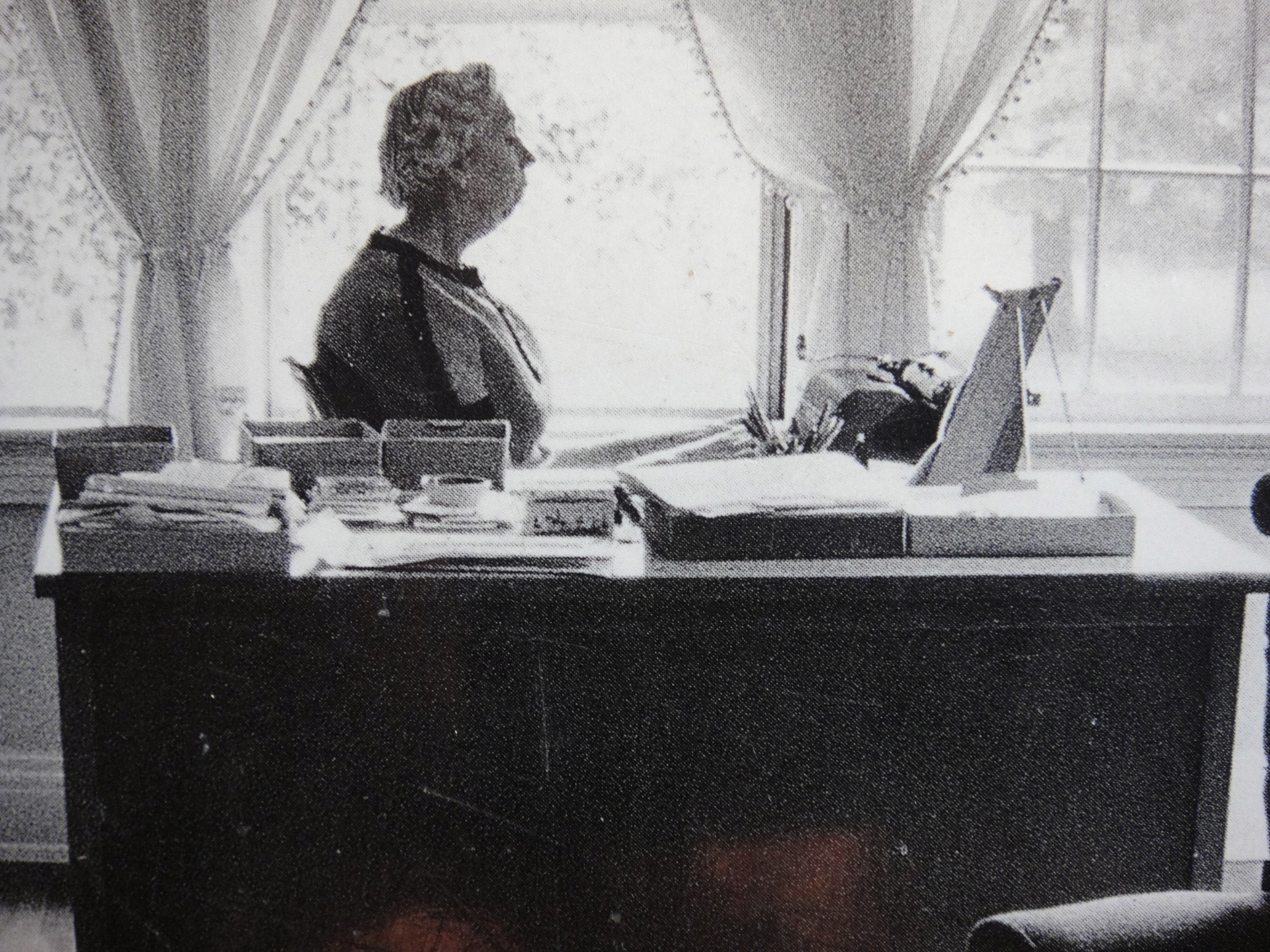
I’m addressing my own questions for this week out of order today–for a good reason. I’ve been on the road for the last week, visiting family in Alabama with my Nashville grandchildren in tow. As long as I have my laptop along, I can usually find time to write, but I become aware of how much difference it makes to have an optimum setting.
I visited Jackson, Mississippi, in February and saw the room where Eudora Welty, one of my literary heroes, wrote. The sight of her books still stacked everywhere made me feel right at home.
In Write Your Heart Out, McClanahan mentions photographer Jill Krementz’s book The Writer’s Desk. Just browsing the pictures I could find on line made me want the book. Likewise, Lenoir-Rhyne University, located here in Hickory, NC, published a lovely book What Writers Do, to mark the twentieth anniversary of their exemplary Visiting Writers Series. Along with works by the powerful panel of writers who have appeared in their on-going series, the book includes photographs of writers’ work spaces. There is no common denominator.
My ideal setting varies. When I need to meet deadlines–mine or someone else’s–I have to get to neutral territory. Copperbean or Taste Full Beans, two local coffee shops, are my favorite spots to settle in and write or revise. Most days, though, I’m settled onto my sofa with the laptop balanced on my lap, clicking away and ignoring the television. I do jump up to move clothes to the dryer or to answer the phone (always a telemarketer). I might snap a picture of my own work space. I invite you to do the same.
Week One: Writing Our Hearts Out
Welcome to our Summer Writing Workshop! I do encourage you to get your hands on a copy of Rebecca McClanahan’s book Write Your Heart Out if you can. Even without it, you can join us in any of the writing activities, but the book is a rich source for continued writing. What I especially like about this text is that she focuses on the reader’s purposes and needs, rather than her own.
We’ll look at the introduction and the first two chapters this week as we get started. You may choose to keep a journal of your writing and notes or you may prefer to journal on your computer. If you wish, you can keep everything you write to yourself, but I encourage anyone who will to post in the comments section each week and to take time to read and comment on others’ posts.
While you could sit and address all the questions and ideas at once, you might consider writing a little every day this week, dealing with the questions or topics that strike you as significant in your own writing journey.
Part I: What kind of writer are you? To get your writing muscles loosened up, l want you to think—no, write—about you as a writer, answering any of the following questions that apply to you:
Describe your relationship with writing and words (from childhood to now).
How do other people see you in relation to writing?
What are your writing habits? Do you journal? Is there a regular schedule or pattern to your writing?
Can you describe a time when you have been writing, as McClanahan calls it, “to save your life (and other lives) from extinction?”
Where are you on your writing journey? Just beginning? Continuing?
* * * *
Part II: Why do you write? People who feel driven to write do so for reasons those who don’t feel the same urge may not understand. In the introduction, McClanahan lists ten rewards writing offers that other activities do not (which I distill here). Which ones hit a chord with you? Which ones had you not considered—at least not in these terms?
- Writing it down leaves a trail.
McClanaham describes things we think we’ll never forget—but do unless we write them down. This struck a chord with me. We call one of my sisters “Remember When Jeannie.” She has such a detailed memory of things my children did that have completely slipped my mind. Likewise, I sometimes come across the fragments of my own writing—letters, journals, diaries—and my former self reminds me of precious moments, funny expressions, momentous events I might not have remembered otherwise.
Shakespeare acknowledges the preservative nature of writing in his Sonnet 18: “So long lives this and this gives life to
thee. . . .”
- We write to reflect and process experience.
Writing slows us down, gives us a chance to process our thoughts, emotions, and experiences. She emphasizes in the introduction and throughout the book the healing power of writing—not necessarily forgetting pain and loss but reshaping them and putting them into context.
- Writing helps us to sharpen our focus,
Writing often forces us to pay attention to details and gives us the opportunity to name our world. We give voice to our own story. When I take the time to analyze why I like certain writers’ works—poetry or prose—I recognize that it is the sense of the specific, whether literal or figurative, that makes writing come alive, that makes it memorable to me as a reader.
- Writing creates community and revives the past.
While many people see writing as a solitary activity, it can also make us part of a community in many ways. McClanahan likens writing to “hosting a party where all the people you have known, been, or imagined show up at your door.”
This idea particularly resonates with me. One of my favorite features of the New York Times Book Review “By the Book,” is arranged in a Question/ Answer format. The interviewee, generally an author with a recent book publication, is usually asked which three authors he or she would invite to a literary dinner party. Because it’s an imaginary occasion, the option to bring together authors living and dead creates the potential for rousing dinner conversation.
My own writing gives me the chance to bring my grandparents and great grandparents back to life, to revisit old friends from the past, to preserve the stories they told me. In fact, through the attempt to write about them, I often uncover stories long lying fallow in my memory.
While many people write with no intention of publishing—or even sharing—others find a source of satisfaction is sharing with actual readers. My own poetry writing was rekindled when I started engaging in Robert Lee Brewer’s Poetic Asides blog, where I found a community of writers eager not only to share their own poetry but to read and to respond enthusiastically to mine.
In his book, Love and Death at the Mall, YA author Richard Peck said (and I paraphrase) that people read fiction for a sense of recognition. I believe people poetry for the same purpose. Certainly, we sometimes read to escape, but I think we’re also looking for ourselves or, more specifically, to confirm that others have felt the same way we have, have had the same heartaches and joys.
* * * * *
Part III: What keeps your from writing?
I’ll confess that when I hear of someone famous who didn’t publish until after the age of fifty, I feel a tremendous sense of relief. (I used to feel the same way when I was forty.) While some people see writing as very hard work, I actually enjoy writing, yet I find myself postponing writing sessions, or if I do write, I don’t finish what I begin.
In Chapter 1, McClanahan discuss why we don’t “write our hearts out.” What excuses do you make for yourself? I sometimes feel guilty, as if writing is a hobby that keeps me from doing the things I should be doing (laundry, yard work). Ironically, writing has permanence; chores have to be done over and over and over.
The most important point she makes is that nobody has time to write; everyone has to make time to write. She deals with misconceptions those little devils over our shoulders whisper in our ears—that we have nothing to serious to say, that we aren’t real writers unless we become published, rich, famous.
What do your voices tell you as they attempt to keep you from writing? Do you also have the little angel counterpart over the other shoulder saying, “Just sit your butt in the chair and start writing”? If so, listen to her.
* * * * *
Part IV: Making Time and Space to Write
Take a minute to imagine—and if you are willing to share, to describe–yourself in the place you feel most comfortable writing. Are you in a quiet place or is there music or the television playing in the background? Are you alone or are there others within your peripheral vision? Do you write best at home or in your office at work? Do you have a favorite coffee shop or library where you can write more productively?
Are you writing onto a screen with a keyboard or by hand? Do you prefer pencils ( I love Black Warrior pencils, freshly sharpened) or a particular pen? Yellow legal pad, spiral notebook, unlined journal? Do you write in bursts of paragraphs or do you start with lists? Do you add doodles?
At what time of the day are you most productive? How long do you write at a stretch? Do you set time blocks or minimum page lengths?
Next important question: How’s that working for you? If it is, then how can you make sure you can create that ideal environment on a regular basis? If it’s not, why not try to shake it up a little. Rebecca McClanahan had several suggestions in Chapter Two:
* Changing your writing location or moving from your chair to the bed. Some people find that using a standing desk is energizing.
* Set a timer. Decide how long you are going to write each day. One of my favorite North Carolina writers Ron Rash manages to write prolifically—novels, short stories, and poetry. I have heard that even when he’s on a book tour, he writes a minimum of two hours a day.
* Remember: thinking about writing isn’t the same as writing. You have to make an appointment with the page.
* Set a page length. Decide you’re going to stay at your station until you write a set number of pages (or words if you’re at the computer, which can count for you).
* Lower your standards. This suggestion from McClanahan implies that we may paralyze ourselves as we try to write masterpieces or polished drafts. Anne Lamott in her classic work on writing Bird by Bird has a chapter entitled “Shitty First Drafts,” in which she recommends giving yourself permission to get it on a page first and to polish later. Computers simplify the process.
As an analogy, consider how your photography experiences has changed with the introduction of the digital camera (or camera phone). I remember how economical we had to be with camera film, not knowing if we got a good shot until we picked up prints at the drug store a week later.
In fact, I recall a fruit bowl full of exposed film canisters, as we put off printing them. Now most of us snap away, knowing that we can delete the bad shots—immediately. We don’t have to experience the regret of missing or blurring a priceless moment. I’ve heard that for professional photographers, the goal is one good shot out of six taken.
Applying that principle to our writing, then, what if we just “snapped away,” writing with the prospect of viewing the finished text later in order to mine for the jewels?
Take time this week to vary your writing practice to see what works for you. Rather than giving specific writing prompts, I suggest that if you don’t have a specific topic you plan to explore right now you should write about your writing habits and practices. Loosen up those stiff writing muscles if you necessary. By all means, log in and share this week, or email me at nposey27@gmail.com.
Get Ready to “Write Your Heart Out” in June and July

Beginning June 1, I’ll begin posting writing activities for the week each Monday through the end of July, using Rebecca McClanahan’s Write Your Heart Out. The charm of the book is that she doesn’t tell you what to write, but she gives nudges in the direction of what you want to write.
While you don’t have to use the book to join Sandy and me on this two-month writing journey, I certainly recommend it. Look first in your local (preferably independent!) bookstore. I will also share related pieces from time to time too. Feel free to share what you write in comments, but you may keep your writing to yourself if you choose.
Our main goal is to accomplish some writing this summer with the help of mutual encouragement.
After the Alphabet
 I enjoyed my April journey through the alphabet, especially the chance to share responses from other writers, and I completed the Poetic Asides Poem A Day Challenge as well. Now I find myself in an unstructured May, with the school year completed and endless possibilities lying ahead.
Last summer I took part in an online class on Flash Memoir taught by Melanie Faith. Since my “found cousin” Sandy was the other “student,” we had a chance to share stories that overlapped in some areas. This summer, we have decided to spend June and July with our own writing class based on Rebecca McClanahan’s Write Your Heart Out.
Already, as I read through the book, my notes in the margin are growing. I know that the biggest challenges will be picking and choosing which activities to pursue, which to put on the back burner. What drew me to the book, other than McClanahan herself, a wonderful writer and presenter, is the way it can be tailored to whatever type of writing one enjoys. I write more poetry than Sandy does, though we both have a bent toward blogging. My topics seem to be all over the place; she has certain areas she continues to explore, going deeper and deeper.
We learned last summer that even when the story we share is one we experienced together, the details change as we filter them through our memory. After all, fact and truth are not synonymous.
We’d love to have others join us on this little writing journey. I’ll post writing prompts here and links to some supplementary texts. Anyone who wants to join us is welcome to share through the comments or on some other platform we create. You don’t have to have the book, but I do recommend it. I can’t wait to start writing my heart out.
For you Drive-By Truckers fans out there, yes, there is a real Zip City. Though born and reared in the same county, I didn’t actually live there myself, but my father was born in Zip City and my grandparents lived there all their lives. Located just south of the Alabama-Tennessee line, the community had the distinction all the time Lauderdale was a dry county as a pass-through on the way to the bars and beer joints just over the Tennessee line. My grandparents moved from the home where my father grew up when I was young, but I can still remember being given baths outside in the washtub, since they didn’t have indoor plumbing. We thought the “new house”–a basic ranch-style brick house sitting right on Chisholm Road was a mansion.
I can still smell the house, a pleasant mixture of home cooking and Pawpaw’s Aqua Velva. The formal living room, where the grownups rarely ventured had a Victorian sofa and pictures of Pinky and Blue Boy over it. The den had pine paneling popular in the fifties and sixties. The sliding glass doors on the tub were etched with silhouettes of swans, and the walls were pink tile.
In the summer, though, we rarely spent time inside. My grandparents farmed. They had other acreage nearby, but we spent time in the huge garden out back where they grew strawberries, cantaloupes, and watermelons, potatoes, beans, peas, okra, and corn–and plenty more. My sisters and I were city girls in comparison to the Zip City neighbor girls our ages, so we felt we were on an adventure when we visited my grandparents. We’d help pick fruits and vegetables, catch tiny rain frogs in jars, chase baby pigs.
A ride to Haygood’s General Merchandise was a great treat. It was the perfect old-fashioned country store. My dad tells me that in the Depression, when people often lacked money for groceries, they’d barter. His mother would tears a strip of fabric and use it to pinion the chicken’s wings. He’d hold the bird as his daddy drove to the store. One of his cousins had a chicken he’d use for trade. After the merchant tossed it in back (with the others), it would find its way home to be bartered again.
My grandparents always had metal folding chairs in the carport, where they’d sit and watch the traffic go by. She’d shell beans and peas; he’d listen to tapes of sermons on his old cassette player. Nowadays I take so many photographs that I can’t believe I don’t have a single one of them sitting there in their front yard, the old black sedan in the carport with mimosa sprouts growing out of its bumper. I guess the sight was so commonplace I never thought to capture it. I’m sorry now.
My grandmother worked until retirement in the cafeteria at Wilson School, a place she loved. My cousins went there, but I never did (although for a few years I joined the school troop there, along with three other friends from my school). My granddaddy continued to farm, but managed to get a job during hard times as a crane operator at Reynolds Aluminum, where he worked for 35 years. He gave me his retirement tie clip with its tiny diamond chip.
They were both faithful members of the Salem Church of Christ (the same one DBT mention in their song), where my grandfather served as an elder and taught the “young men’s training class.” He had only a third grade education (though I am told he stayed two more years and taught third grade curriculum to the younger students), but he taught countless young men to deliver a talk and to lead singing. Then he hauled them to churches all over North Alabama, Mississippi, and probably Tennessee, so they could lead church services.
When I began teaching, I had a particularly cantankerous red-headed student who lived in Zip City. He gave me nothing but grief in class, but after my grandfather’s eyesight grew so weak even he knew he shouldn’t be driving, Shannon would pick up him and Mama Coats for church. I walked into my grandfather’s hospital room–his first time there and he was in his eighties–and there sat Shannon, holding the sweet old man’s hand.
There must be something special in the dirt there. The rain was never dependable–not enough when they needed it, too much when they didn’t–but the folks there were made of tougher stuff than many of us today. I hope a little of that runs through my veins. Maybe I don’t even need the photographs.
Y Is for Yours Truly

I’ve had the dubious honor of teaching college students how to write business letters. What I’ve learned, other than the need to repeat myself frequently, is that too many people don’t know how to write any kind of letter. In the past, I could explain the distinctions between the “friendly letter” format and the business letter, but most of them don’t know that either.
I have to remind them that their own name goes not at the top above their address and not in line one (“My name is Jordan and I wanted to write to ask you. . . ), but after the complimentary closing. The exception, of course, is if you are Apostle Paul, in which case you may mention your own name in the first verse, alone with all that dispensation of grace and greetings.
I’m not agonizing so much over business letters, though. I miss personal, handwritten letters, those wonderful, serendipitous surprised that used to appear in the mailbox, along with the bills and grocery ads.
I have always been a letter writer. Even with email and social networking at my fingertips, I love to write a real letter, stamped and sealed, posted in the mailbox, with the requisite day or two delay. I learned long ago that letter writing, like marriage, is not necessarily a fifty-fifty proposition. If I have something to say, I don’t wait for a reply to my last letter. I might be waiting forever. People who don’t get around to answering letters still enjoy getting them—and they do help to maintain long distance friendships.
When I was a college student, letters from home and from friends were my sustenance. I certainly wasn’t lonesome or homesick, but I still checked my mailbox (no. 58, combination J-H-F) two or three times a day. I got letters because I wrote letters—and because I had people who loved me back. I still have those letters—most of them anyway—in boxes in my attic. They are one reason it takes me so long to clean the attic. I stop and read them. Or re-read them.
Now that many youngsters aren’t even learning to write or, consequently, to read cursive—a horrible discussion I’ll save for another day—they are less likely than ever to know the pleasure of writing a letter, signing it with “Love,” “Sincerely,” or “Yours Truly,” and meaning it.
I don’t write as many as I wish, but I find that laying the supplies helps. I keep a drawer filled with postcards, note cards, envelopes, and correct postage—Forever stamps and correct postage for post cards. The odds are much better than Powerball that I will get return letters, at least from some of those I care about enough to make the effort, to share a funny story, or to send a clipping that just made me think of that particular person.
I want them to know that I remain
Very truly yours,
X isn’t always for Xylophone
I confess that I play the alphabet game in my head quite often. Sleep sometimes eludes me, so I have a number of games I use to help me turn off my head. They often do the opposite. My most frequent is a version of Text Twist in which I think of a six-letter word and try to form words of three letters or more from it. I start with the first letter, working my way through, counting on my fingers. If I don’t think of at least twenty, then I have to start with a new word.
I use songs or poems to find the words; otherwise, I’m stuck with things in the room (carpet, bureau, drawer, window).
Sometimes I think of two related words with the same number of letters and try to start with one, changing one letter at a time to form a new word, until I reach the other. The fewer steps the better.
The alphabet game, though, like the Blogging Challenge this month, is a go-to game. Think of a country with each letter, a student in my classes…, a vegetable, a store, an author’s last name, a song title. Some letters pose problems in certain categories, but X is the most obstinate. As a kid, we always used xylophone for X. It’s in all the children’s books. Over the years, though, I’ve used x-ray, Xanadu, and Xaveria Hollander (the Happy Hooker). I was thrilled to learn how many foreign languages use X at the beginning of proper nouns—China certainly does, with all those X’s that sound like Ch’s.
Of course, there’s always the cheating method of choosing an eX- word. That might have been an eXcellent idea today.
Benjamin Franklin, I believe it was, proposed a simplification of the alphabet, eliminating all the redundancy—soft C, hard C, Z, and S. You know the culprits. Maybe he has an eksepshunal idea!
 Alabama Tar Heel