Another Kind of Broken Heart
 My daddy’s mother always considered herself sick nigh unto death–even though she probably accomplished more than most women–and a lot of men. Daddy remembers when he was young and she was probably on in her twenties that she would tell them, “Boys, this may be my last Christmas.” She lived into her late eighties.
Mama Coats had problems with blood clots. Part of the problem might have been all those years she spent on her feet, working as one of the “cafeteria ladies” at Wilson School. I don’t know how many years she worked there, but somehow I never even thought to consider her a working woman, even though work is almost all she ever did.
She loved the kids at school, telling us such funny stories about them. Since she worked before school cafeterias adopted the “serve them what they’ll eat” mentality (the last major movement before the current shift), they served up real food–local vegetables, meat other than chicken fingers and ultra-thin hamburger patties. Back then, in fact, chickens didn’t even have fingers. She told us once they when they had served stewed okra, a food I love but which I realize most kids don’t, one student told her he had to cross his legs when he ate slimy stewed okra so it wouldn’t slide right through him. She passed that along to us, enjoying its innocent naughtiness.
Perhaps part of the reason she had clots and eventual heart problems could be traced to her cooking. I’m sure she used more lard and shortening than Canola oil! She ended up having a pacemaker, after which she was cautious about her activities, fearing that reaching across the frame when quilting might pull something loose. Somehow it didn’t stop her from beating a gopher to death when she caught him trying to eat her garden crops.
To counteract the clotting problem, evident in her black mottled legs, the doctors prescribed blood thinners. The slightest injury could result in heavy bleeding. Trying to get from her hospital bed to the bathroom by herself once, she accidentally pulled loose an i.v. and the nurses found her amid a puddle of blood.
With those memories firmly implanted, I had to help my husband make a decision when his doctor decided he needed aortic valve replacement. The diagnosis was not big surprise. His father had the surgery at eighty-five and lived until he was ninety-nine. His brother had three such surgeries, and many of his cousins and uncles as well. He had always suspected it was more a case of when than if. The decision, then, was whether to go with a tissue valve (bovine or porcine) expected to last an average of ten years or a mechanical valve that, with luck, could outlast its owner. The decision to go with the mechanical valve might have been an easy one. After all, he’d seen his brother outlive one pig valve, eventually having his own mechanical one. The prospect of having to go back in for heart surgery in his seventies wasn’t a pleasant one.
The only drawback was that patients with a mechanical valve must take blood thinners (Warfarin) for the rest of their lives, going in regularly to the doctor’s office to have the INR level monitored. Individuals on this medication must also be consistent in their intake of green vegetables–the ones we’re encouraged all our lives to eat–since they promote clotting, affecting the work of the blood thinners.
Even after healing properly, he found that his heart and his medication would affect everything. He needed some oral surgery before the dentist put in a permanent crown, but that meant coming off the medicine and taking shots (given by yours truly) twice a day. He went back to the dentist for other options.
Not so lucky with the every-so-many-years colonoscopy. Because of his medical history, they gastro doctor required him to visit a cardiologist for an okay. This took two office visits and an echo-cardiogram (a thousand dollars thrown to the wind). He had to stop the pills, and I had to give the shots–for a week before and two weeks afterwards. He developed a Pavlovian instinct, cringing whenever I neared him with the hypodermic needle. He wore the ugly bruises on his belly, which faded gradually for days afterwards. Even the procedure itself had to be done in the hospital “just in case” instead of the office, where we had always gone before.
Finally, we’ve gotten back to normal. He takes the handful of meds I put in am/pm slots for every day, and after a couple of doctor visits, his numbers are right in the target range. We hardly think of his health conditions most of the time–unless I decide to put turnip greens on the menu.
The most obvious reminder of all he’s been through comes at night, when we quieten down to sleep. Above the croaking of the frogs in the neighbors’ pool, I hear the tick-tick-tick of his valve doing its job. Surprisingly, though, it doesn’t bother me the way the crocodile’s clock haunted Captain Hook. Instead, I sleep like a new puppy put to bed with an alarm clock, the ticking reminding me that everything is working just as it should.
The View from the Empty Nest
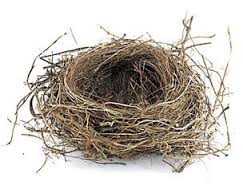 Following my own suggestions, I’ve been thinking about how to explain the emotions that result from the empty nest. At risk of oversimplifying, I would borrow the Facebook relationship status and say, “It’s complicated.” My three grown children live in three different Southern states–none of them in this one. That’s what happens when you let them go off to college: they don’t come back.
On the bright side, none of the three is living upstairs, surfing the net for jobs. They are all three independent, just as we hoped they would be at this stage of life–28, 33, and 35. On the other hand, we celebrate Father’s Day and Mother’s Day with phone calls and a card, even a package through the mail.
When my children were small, I remember friends who expressed dread at their children growing beyond the “baby stage.” By contrast, I always loved and welcomed each stage. Certainly, once a child realizes walking is not merely a party trick but a means of transportation, everything changes around the house; however, after the frustration preceding walking (and later, driving), these first steps are reason to celebrate. Laura, my oldest, walked before nine months; Ben, the baby, waited until his first birthday. This may not have been as much about delayed development as about his being carried around by Laura and John. How can a child learn to walk when his feet never touch the floor? Why learn to talk when you can go, “Unhhh. Unhh,” and have your own personal translator on hand? (“Mama, he wants. . . .)
These days though, we can pick our own television channels and blast the music we like without criticism or complaint. We dine on whatever the two of us choose at whatever time suits us. We are decades past ball games and practices, late night homework and last minutes school projects. (“Mom, I think we need to get some poster board. Tonight.”)
Although Laura left home for college and didn’t return, the boys both have rooms of their own in this house. They spend at most a few days a year in them, but the belongings they ‘ve left behind serve as placeholders. Both boys have left behind clothes, yearbooks, various inoperable computer and stereo components, books, magazines, and more. In the attic, I have boxes devoted to each child where I add photographs, school souvenirs, school certificates, and funny cards.
For weeks after Ben, the youngest, left home to work in Florida, his first job as a college graduate, I could hear the phantom clicks of his dog Jack’s toenails, even though the dog had been put to sleep just days before after suffering with heart failure. I didn’t think I even liked the dog (who ate my door facing every time a rain storm blew in when we were away), but I felt bittersweet nonetheless.
I might kid the children, claiming that I miss most their technical troubleshooting skills, but honestly, we have our cell phones, so they still have to respond whenever I forget how to play a DVD or to figure out some other computer-related challenge. I figure it’s the least they can do after all the homework help–or even the labor pains. I keep a long list.
These days, we can go to dinner without a sitter, go on vacation without making arrangements at the kennel. We can be as noisy as the two of us will allow. We can be silent without arousing concern. We can turn up a Chicago concert playing on the TV, blasting it through the Bose speakers, without anyone complaining, “Mommmmm!” Would I trade the independence to have them all living in town with me? You’d better believe I would.
On Father’s Day: Looking Back at my Life’s Soundtrack
The concept of the mixed tape, now the playlist, can serve any number of purposes. What I might put together as a gift would be selected to evoke memories. Such a compilation for my husband would include James Taylor’s “(Whenever I See) Your Smiling Face,” from the cassette we bought either on our honeymoon or just after. Kansas’ Leftoverture or ELO’s Ole might have to be included in their entirety, along with something from Art Garfunkel’s Breakaway (“I Believe When I Fall in Love”) and Leon Russell’s Will o’ the Wisp.
For my high school best friend, some of the songs would be favorites, while others might be the ones we mocked. I might include something from the Jacksons–“ABC,” for example, or even a few from the Partridge Family (“I Think I Love You”), music we heard on the radio when we drove around town or back and forth between my house and hers. These aren’t the songs that last in our record collections. Those spots are reserved for the Beatles (Abbey Road), Carol King (Tapestry), and Sweet Baby James Taylor, Three Dog Night, Creedence Clearwater Revival.
The dichotomy persists into college, when my musical tastes expanded. If I want to remember fun weekends, I’d have to listen to Kiss singing, “I Want to Rock and Roll All Night (and Party Every Day”) or even (shudder) the Bay City Rollers “S-A-T-U-R-D-A-Y Night!” The music I learned to love back then, though, was Kris Kristofferson, Jerry Jeff Walker, Guy Clark, Willie and Waylon, Emmylou, Allman Brothers, Marshall Tucker Band, and Charlie Daniels Band.
It boils down to this: a real musical time line of my life would have to play out in real time. There are too many songs, too many singers. What I realized, especially with Father’s Day approaching, was the number of songs I associated with my parents, especially car trips.
One of the best memories of early childhood is my mother’s playing the piano. Back then–when I was perhaps second or third grade–Mother had the sheet music for “Memories Are Made of This,” a Dean Martin hit. She’s also play “The March of the Toy Soldiers,” which I think originated on the movie Babes in Toyland. She’d play as Amy and I marched around and around the round coffee table (the one that accumulated tooth marks of all the babies who learned to walk around it.)
When I entered fourth grade, our family moved to Columbia, Tennessee, leaving mother and almost two-year-old Becky behind at my grandmother’s house in Florence until baby Jeannie was born. We drove back and forth each weekend the seventy-something miles with Daddy, listening to the radio. We heard “King of the Road” and “Going Back to Houston” so many times we knew every word.
Most family car trips turned into sing-alongs too. You could ask any of the four of us what song we remember from car trips, and we’d all say, “Pearly Shells,” Don Ho’s second best known hit. We’d sing it straight, then we’d sing “Shelly Pearls,” spoonerizing all the lyrics.
Probably the funniest memory is a trip from Florence to Nashville when Daddy was driving me to college. The way I remember it, we bought a Carpenter’s tape at a filling station and played it over and over and over…. I thought Daddy was going to throw it out the window.
Living in North Carolina, I don’t get to ride with Daddy as much any more, so the chance to ride with him and mother all the way to Cerillos, New Mexico, to visit my cousin Sandy and her husband Frank was a gem of an opportunity. But we didn’t listen to the radio. For one thing, Daddy doesn’t like the noise of the radio these days. As anyone with hearing aids will tell you, too many sounds at a time mean you understand none of them. On that road trip we talked and talked and laughed and talked some more. That was music to my ears.
One-Minute Scenes
Today the son of a couple who went to school with me posted his parents’ wedding picture in honor of their anniversary. His mother Sally died of cancer a few years ago, but I have kept my friendship with his father Mark. I had always thought we all three graduated the same day, since I remembered our conversation at graduation practice. Facebook comments cleared the account. McClanahan’s observations about her three-legged dog came to mind in regard to the way our memories shift and reform. Here are just a few little scenes I started playing with today:
My college graduation:
In my room in Elam Hall, as I was getting ready to line up for graduation, donning the hot black polyester gown, holding the cap and bobby pins to hold it atop my head, the girls at the desk called over the intercom to tell me I had a phone call at the pay phone bank downstairs. It was Jack, someone with whom I had spent the previous evening after breaking up (his choice, not mine) a few months before.
I had run into him–or more literally, he had almost run over me–as I had crossed Granny White Pike to buy a Sunday Nashville Tennessean the week before and he had called as if he hadn’t pulled the previous disappearing act. We’d had a good time, without mentioning the past. I had good feelings about getting back together. Then he called and said, “I just don’t think this is going to work.”
He had said he’d be glad to meet my folks for the first time. I guess he wasn’t. He never did.
Before time to get ready, I rode to 100 Oaks Mall with my parents. My little sister Jeannie, ten at the time, decided to talk Mama and Daddy into buying her a big hanging wicker chair (which meant that some of my dorm room items had to be left behind–a walnut stained bookcase my uncle Robert had made for my dad in high school shop class and a set of Colliers Encyclopedias. I never saw them again.)
The whole time they poked around the mall, I worried because I planned to wash and blow dry my hair–still in something of a shag haircut–before graduation. When we got to the mall parking lot in the late August heat, wagging the huge chair, Daddy’s Cadillac had a flat tire. I knew then I’d graduate without freshly washed hair.
I hardly remember anything about graduation, except that I sat near Sally Clower Crosslin. I always misremembered her brand-new husband Mark having been there too, but I learned today that he graduated a year later. He must have been there at practice the day before to keep her company, since they’d been married barely a month at the time. I mostly remember that I sobbed through the whole graduation ceremony.
Since the Alumni Auditorium was being remodeled (I still have my chapel seat wooden arm I stole at the end of the summer quarter), the school had planned to hold graduation in the Granny White Church auditorium, adjoining the campus, but we had raised a ruckus and convinced the administrators to let us have graduation outdoors. Nothing says “Brilliant” like asking to sit outside in metal folding chairs in August in Middle Tennessee.
Although most people in the audience that day managed to uphold decorum, there were shouts as some graduates crossed the stage for diplomas, especially those who made it through by the skin of their teeth or those who had stories of their own. Gary Y., for example, had been enrolled there for years. We knew he was at least thirty, and girls who had gone out with him enough to know revealed that he wore dentures. When I crossed toward Willard Collins as my name was called, I heard one lone voice cheering in the audience, which I later discovered came from another ex-boyfriend who’d showed up for the occasion.
Even though I had halfway thought I’d stay over in Nashville for a few days with Susan, my old roommate, expecting to see where the newly rekindled feelings took us. Devastated, I decided to leave that night, with Amy driving my car. I thought the world had ended. The next morning, my sister convinced me to visit the church she was attending instead of going out in the country to the little church where Daddy was preaching. Good thing I did. My future husband sat a few rows ahead of me in the Young Adult and College Sunday school class.
Week Three: Exploring “Memory’s Heart”

The Purser Homeplace
Week 3: “Memory’s Heart”
In the first two weeks, we’ve been building up to writing, but now we’re going to start tackling the richest vein of writing—memory. “But I want to write fiction,” you might insist, “or poetry. Not memoir.” As McClanahan points out later in chapter four, when she refers to the merger of memory and myth, that’s okay too.
Be forewarned: There is so much we can do with Chapter Four.
Don’t lose sight of the idea that this is your project. Pick the parts that are most useful to you.
For this week’s suggested activities, if you have a long-range goal this summer, then make selections that will move you toward that end. If not, then just let your memory take you in the ripest directions to see where they will lead. This particular chapter is so rich with ideas for the nitty-gritty of narrative that you may want to go in some different directions from those where I am leading you, or you may plan to come back to this chapter later for re-reading.
Part I: Return in memory to one or more places that intrigue you. McClanahan begins with her mother’s impending sale of a home that had been in her family for generations, a place that had been “imprinted on [her] memory” (59).
Revisit (in your mind) one place from your past. You might start by sketching if that works for you. Can you draw the floor plan? What specific items do you recall? Although I probably spent more time at my maternal grandparents’ home, lately I find myself drawn back to the home where Mama Coats and Pawpaw lived.
You might choose to explore an entire house or one particular room, an entire school campus or one classroom. What objects are in this place? I remember the framed pictures of “Pinky” and “Blue Boy” in the formal living room where company rarely entered. When I enter the house at child’s height, though, I remember the knick-knacks on the little shelves at the end of the counter separating the kitchen and den, in particular a glass cat with little chains attached to two baby kittens.
What happens when you enter this place from you memory at different ages? Look at it from different angles. You might even imagine the view from above when everyone is gathered for a holiday meal.
One of my favorite “poem in progress” activities I used to use in class was to have students remember a window from their past and then to decide if they were inside looking out or outside looking in.
Next, invoke the other five senses. What do you smell? When I wander, in memory, into the single bathroom, with its pink tile walls and swans etched in the sliding glass tub doors, I smell my grandfather’s Aqua Velva shaving lotion. If I open the hall closest, where all the handmade quilts are stored—piles of Dutch doll quilts, flowered appliques—I smell the scent of cedar and polish.
Smell and taste merge, of course, in the kitchen. Okra is frying, or someone is scraping corn from the cob into big metal pans, getting ready to bag it for the freezer. I also feel the cold of metal folding chairs against my once-scrawny legs, sitting at the children’s table.
Now it’s your turn. Decide on your perspectives. Allow your present self to reenter the setting of scenes from your past.
Part II. We all hear the age-old advice, “Write what you know.” You may find plenty of rich settings for writing without traveling any farther back than last week. Follow the cue from page 61 and list all the places you’ve been in the past week: the farmer’s market, a friend’s house, the post office, a local museum or the aquarium. These may allow you to travel back in time as well: your uncle who ran a roadside stand every summer, the stranger in front of you in line at the post office window. Do any of the people you encounter bring to mind people from your past?
What’s the benefit of mining our own past? I was struck by McClanahan’s statement that “to lose your past is to lose the places, people, smells, tastes, and dreams that comprise the album of your life” (63) while, conversely, as she quotes Patricia Hempl, “To write a life is to live twice.” I love Billy Collins’ poem “Forgetfulness,” in no small part because I heard him read it first over NPR on my trip home from visiting my grandmother after she’s had a mild stroke. I had sat at her kitchen table (in that same kitchen I was visiting early in memory) as a therapist helped her recall words for some of the simplest objects—hairbrush, spoon.
Don’t be afraid to step closer in your memory, even if it may be painful. I think of Aunt Gene’s hands after overtaken by arthritis. My youngest son was afraid of her because she had “witch’s hands.” Now I imagine how they must have felt to her. Or I think of the time I sat with a friend’s great grandmother and how I feared I hurt her tissue thin skin trying to help the tiny birdlike woman to the bathroom. I can still recall the feel of her bones through the powder soft flesh.
Take the time to capture these people and places. Remember, though, that sometimes the details will be transformed in the process—and that’s all right too. You aren’t responsible for factual exactness; you are capturing your version, your perspective.
Part III. As you are entering “memory’s room” focus on who is there. To recreate the mood or emotion, don’t rely on abstractions. If your second grade teacher is in that room, then you might try to pinpoint what she did that scared you so. Although Mrs. Hester was probably younger than I am now back in 1963, I thought she was one of the ancients. I imagine her as a sort of giantess, looming over my desk. Little wonder I feigned sickness and asked to go home when I failed a test on telling time, the first failing grade I recall making.
Try following the suggestion to give your scene a “working title” to get your started, “Helping Pawpaw chase the baby pigs through the corncrib” or “Getting off the bus a stop too early without permission to learn to ride Greg’s bike.”
If you are writing about a scene from before you were born, one passed down through the family, or if you are writing a scene from your childhood, trying placing your present self in the scene. You might trying writing about yourself in third person. Strike up a conversation with another person in the scene with you. Begin by asking, “Do you remember the time when…?”
Part IV: Time Line
I love Mr. Hamaker’s definition of history as “the places on the time line where things happened to people like you and me.” Try making a time line of your own life and note “earthquakes and tremors” along it. The “earthquakes” are those events that shook the world—September 11, the Challenger Explosion, the Kennedy assassination. Tremors are those events that shook your small corner of the world—when your childhood home burned, a divorce in the family, losing a friend to death or relocation.
It may help to play the “I remember” game, listing like a poem. Then choose a starting point and write, using special attention to sensory details. Imagine you’re looking through a camera lens. Do you need to move in closer or to back up and take in a wider view?
In writing class, we used to refer to “exploding a moment” and “shrinking a century.” Authors have to do both. Neither fiction nor nonfiction operate best solely at real time. As you read this week, pay attention to times when an author may take a whole chapter to describe what is actually a two or three minute scene. Then notice how, by contrast, the author may describe the passing of a few years in just a sentence or two. You are the author now. Which choice makes the best sense for your purpose? Try both.
Try McClanahan’s suggestion and pick one particular day, but instead of detailing it all chronologically, compose a series on one-minute scenes from that day. They don’t even have to be written or read chronologically. If I were to write about my wedding day, I might start with the moment we realized the rainclouds had rolled in and the only way to the back of the church was outdoors.
Part V. Warm up with some of the list activities in this chapter. I attended a fiftieth anniversary party this weekend, and the couple’s daughter had a string of fifty cards on ribbons, with an entry for something related to each number 1-50. One had the number of cars they had owned; another, in how many different states they had lived. The author suggests in this chapter that being asked to list her three favorite songs by the Rolling Stones sent her back to specific times and places (and automobiles), she’s onto something Tennessee Williams observed: “In memory, everything seems to happen to music.”
Try listing favorite songs—year by year, or all the places you’ve lived—or vacationed, old boyfriends, jobs you’ve held, pets. If you have the opportunity, ask your oldest relatives or family friends to makes similar lists for you.
Part VI: Experiment with McClanahan’s variation described beginning on page 76: Don’t just retell a story, but tell about the “telling of the tale.” We all have family stories that vary enough from one person’s telling to another to make us aware that the “truth” may lie somewhere in between—or far outside the telling. Release faithfulness to fact in favor of truth.
The narrative device of the telling may free you to take the story you want to tell in a direction you never expected.
June 12: Reader’s Discomfort = Writer’s Success
 Looking at my own instructions at the beginning of the week, making abstract emotions concrete, I caught myself in an all-too-familiar experience today. I got back to the house after spending the morning helping our friends’ daughter and two grandchildren decorating for Gayle and Dennis’ fiftieth anniversary party tonight. I got there early–I thought–and parked in the shade in from of the Mosteller Mansion, waiting for someone to arrive. I turned my car to “accessory” so I could listen to my audiobook, Disclaimer by Renee Knight.
The book is quite suspenseful, with alternating readers. The first person narrator is actually the antagonist, while the woman whose life is told through a third person narrator is actually the protagonist, or at least the most sympathetic character of the two.
As the story has progressed, revealing little bits of the mystery, but never enough, I find myself with this gnawing discomfort in my stomach. Even when I’m not listening to the CD, I’m feeling vaguely queasy. I wasn’t able to put my finger on what was wrong at first. It took me awhile to realize I was experiencing vicarious unease.
The same thing happened awhile back when I listened to Garth Stein’s The Art of Racing in the Rain, a novel told through the point of view of a dog. Nevertheless, having to stop the story, get out of my car, and teach, I carried the weight of suspense. I worried as much about that the predicament of the dog’s owner as if it had been my own.
I realize that when I write fiction, I am too protective of my characters. I keep them just out of trouble, which would be fine if I were their parent, not an author wanting to make readers keep reading. Now that (a. I realize what I’m doing and (b. I know as a reader I want trouble–as long as it’s resolved in a satisfactory way, it’s time for me to turn back to the story that has become my focus this month.
Answering My Own Questions
I’ve already had a couple of hours of productive work at the public library today. This summer I made up my mind to spend at least two uninterrupted hours a day working on my writing, and I do that best somewhere away from my house, not because my husband is working there, but because of all the other things that beckon–laundry, dishes, cooking shows, books, magazines–nothing bad, but nothing that leads to successful writing.
Looking at the questions I posed in Part III this week, I realize my answers are likely to be indirect and ongoing. Since we all have limited time–even though we can’t see the finish line–I might as well write as if I want to get some projects accomplished. What I’ve discovered by some of my reflection so far this month is that I start too many writing projects and finish too few, so I have decided I needed to pick one major project I want to complete and then some smaller, doable projects.
From my folders of work in progress, I decided to focus on a novel in progress. The story is based on an idea I had more than twenty years ago that has kept nagging me to write it. I’ve finished the first few chapters, but then I have other chapters from the middle of the story.
I also have a blog idea my sister and I are exploring, putting together the first several posts and thinking of ways to introduce it in a way that might get some attention. Finally, I have a gift project I mentioned earlier, and now that I have copied a few pertinent paragraphs from Kazuo Ishiguro’s The Buried Giant, I can start that too. That should be enough to keep me busy for awhile, right?
June 10: Keeping It Private
I started my own journaling today, answering my Part II questions, and discovered that truth-telling doesn’t always require sharing. You may find the same to be true. I may post a few of my notes, but probably not all. You won’t either.
In a little side note, I’m listening to The Buried Giant on the iPod while I’m walking, and I had a great brainstorm for a writing project for our upcoming 38th anniversary. Now I need to find a copy of the book (so I don’t have to “rewind” on the iPod) to help me focus this little writing project. I’ll share the details later.
June 9: My response to my own Part I
Since we’re talking about journaling here at the first of Week 2 of Writing Our Hearts Out, I thought I’d try to do some of both this week. Since Sandy recommended the site Penzu.com, I’m planning to try it. For now, I’ll stick to the freebie version, and if I decided to “upgrade” to make it prettier or to personalize, I can do that when I wish.
I have honestly tried every format imaginable. I still have the first diary I ever owned. It’s a small pink one-year diary with little spaces for each day. I didn’t fill it completely, and I didn’t start it for years after receiving it as a gift. I finally wrote in it inconsistently one year while I was in college, and later I found that I had recorded a mention of my future husband. At the time, my diary entries were sad little records of my dejection at rejection. A boyfriend had graduated, moved back home, and faded away. When I read the entry, years later, of a visit my sister made to campus riding with a group from her church back home, driven by Dick Posey, I didn’t even remember his being there. All that time I spent pining away with what I diagnosed as a broken heart, and there he was right in front of me!
I read of writers who keep journals religiously, using the same kind of notebook, storing them side by side on bookshelves, and I feel a kind of envy. Not enough, though, to follow through. I probably have just as many notebooks, partially filled, all different sizes and styles.
This is what I do know about physical journal preference: I like a book that will lie flat, and a spiral notebook form is particularly comfortable. I prefer lines. I manage to keep up with a small purse-size notebook best, even if I have larger journals. I know I need a place to store snatches of conversations, little ideas of lines that come to me as I drive or when I should be paying attention to something else. I often “harvest” these little books for poems or stories underway. For really rough drafts or note-taking, I prefer a long yellow legal pad and a fine-point black Sharpie pen.
Several years ago, author Dori Sanders described her method of collecting ideas for writing. Since she worked at the roadside stand of the family farm, she kept paper so she could jot down notes, which she would put into a jar or box until she needed them. She got the idea for her novel Clover from observations there. She saw two funeral processions pass in one day, one white and one black. A little girl in one car caught her eye and gave her a shy little wave. She said, “I just picked her up out of that car and put her in the other, next to the sad looking white lady.” Ta da.
If I didn’t think I’d just lose them, I probably would use 3×5 cards, my favorite office supply ever. They are a perfect size to carry everywhere. Since I also have the (inadvisable) need to use a book mark when I read, moving it down the page under the line I’m reading, they’re always handy. I also write down words (and page numbers) I want to look up. No doubt, one of my writing challenges is trying to organize my thoughts and ideas. I have folders and folders of story starts (multiple copies with notes from my writing group.) I also have at least five flash drives, all hooked together.
For now, I’m going to try to be a keyboard journalist, keeping EVERYTHING right there in penzu –well, everything except what I already have somewhere else! I have a prodigious talent for keyboarding, dexterity I pray will sometimes translate to my mandolin playing. When I write faster and faster by hand, I become more illegible. When I type, I can feel typos as I make them and correct them almost effortlessly. I can type almost as fast as I think.
Moving to another question I asked in Part I of this week’s notes: I’m not sure if my moods affect my writing. I think they change my genre. I’m not necessarily a confessional journalist. To be honest, if something’s really eating at me, I’m more likely to compose a poem–in third person or from another voice. I am great at disguises. I don’t tend to get caught in particular highs or lows. (What’s that old joke? I don’t suffer from stress; I’m a carrier. I think I suffer more from others’ highs and lows.)
Now, acting on my summer goals, I’m going to spend a little time going over one writing project I think deserves my full attention for awhile. I’ll report back.
 Alabama Tar Heel