M is for Merlefest

The countdown has begun. A week from tomorrow, Merlefest 2015 opens. I’ve lost count of how many times I’ve attended this festival just up the road in Wilkes County, but I know that I’ve also gotten to take a few people along for their first experience too. Merlefest is not just a little local festival either. Lots of people come from all over the United States every year. The campgrounds are full; in fact, lots of people stay up into the wee hours playing music after the shows end each evening.
Merlefest, for those who don’t know, is a four-day festival started about 27 years ago in Memory of Merle Watson, the son of the incomparable Doc Watson. Held at Wilkes Community College, this festival is one of the most family-friendly eclectic music experiences I’ve even seen. So many people who have avoided attending, expecting a crowd and a mess are surprised when they finally discover quite the opposite.
Throughout the day, performers play on at least a dozen stages, and as the day wind downs, everything wraps up at the Watson Stage. Yes, there’s plenty of bluegrass and old time music, but there’s plenty more. Some of the headliners this year include the Avett Brothers, from up the interstate, Marshall Tucker Band, Robert Earl Keen, Lee Ann Womack and Dwight Yoakum. The regulars include Sam Bush (my mandolin hero), The Kruger Brothers, Scythian, Blue Highway, and the Steep Canyon Rangers.
One of my favorite events is the Waybacks’ Hillside Album Hour. This band out of California surprises the crowd by covering an entire classic album, bringing in the other major performers. They’ve played Abbey Road, Jimi Hendrix, Bob Dylan and the Band, and last year Crosby, Stills, Nash, and Young. They issue “Google-proof” clues, so the speculation flies, but the audience doesn’t know for sure until the opening notes. (Check Hillside Album Hour on Youtube to see the crowd erupting when “Purple Haze” starts up three years ago.
Even with the huge crowds, parking off site is simple since the local scouts and church groups provide bus rides back and forth. The food venues (also churches and local organizations) is tasty and affordable. (My favorite–the grilled chicken plate). Even the port-a-johns are more like little mobile homes. They’re clean, heated, and even have sugar scrub for your hands and little vases of flowers by the sinks.
The hardest part of attending Merlefest is deciding where to go. Sometimes my favorites overlap. Even when you just walk around the campus, there’s music everywhere.
This will be the second or third year without Doc. His spirit’s still there, along with his grandson Richard and so many of the musicians he mentored over the years.
This year, for the first time, I’m signed up as a volunteer. I’ll be escorting people up to the Watson Stage for photo ops. I know by now to pack well–folding chair, and sun screen. I’ve also learned the hard way how much the temperature varies during the day. I’ve gone in sandals and wrapped my feet in toilet tissue by the end of the night (not a pretty sight). I’ve bought hoodies before too. This year, I’ll have my backpack loaded in advance, my camera battery charged, and my schedule mapped out for the shows I don’t want to miss.

L is for Libraries
I’m running a day behind, but with National Library Week coming up, I couldn’t miss this opportunity. Throughout most of my life, I’ve had life-shaping experiences in libraries. When I started first grade, my best friend Elaine’s mom was our elementary librarian. I know I’ve written about Mrs. Comer (now Epperson) several times in the past. In fact, my other blog (discriminatingreader.com) is a tribute to her. She lit a fire in me that has never been extinguished. As I have mentioned before, she would give us books the way drug dealers get kids on the playground hooked on pot so they can entice them to stronger stuff.
She led us to The Wizard of Oz, Little Women, Island of the Blue Dolphins, Charlotte’s Web, and so many others. I did my best to monopolize her time when we had a library day, asking her to help me find the next perfect book. That’s why, in my third grade year book, she signed with the note, “To a very discriminating reader.” When I asked her what that meant, she said, “Some day, little girl, you’ll understand.”
Not all the librarians had that same charm. One we called “Sweat Bee” for her frenzied, angry attacks when anyone acted out of line in her sanctuary certainly had no positive influence on my reading habits, but she didn’t squelch them either. (I do know she made herself a target for pranks. Students asked her to sign their yearbook, which she did, not realizing it was actually the library copy. She was also notorious for putting strategically placed Bandaids over the models in the Sports Illustrated Swimsuit Issue.)
Much of my summer time was spent in the local public library. I usually visited the Florence Public Library with one of my reading friends–Susan or Debbie. I don’t remember a thing about the people who worked there, but if they were still in the same facility, I could walk right to the shelves where my favorite books and authors resided. During my junior high and even high school years, I would “read authors”: I’d find one book I loved and then read everything that author wrote. I worked my way through all the books of Lloyd C. Douglas after I read The Robe, and then everything by Daphne DuMaurier after Rebecca. I remember reading Exodus by Leon Uris, also a library book, and having to read into the wee hours because I couldn’t sleep if I stopped during some of the more gut-wrenching scenes in the concentration camps.
Over the years, I’ve had confirmed a notion shared by a favorite English teacher of mine: There are two kinds of librarians. Those who love books–and readers–and those who want to protect books–from those pesky readers. They are the kind who say “Shhhh!” a lot. Fortunately, in my teaching career, I’ve been exposed to so many of the first kind, the ones who are always asking for suggestions to add to the library collections and passing along books they love. How refreshing to find library personnel who actually read for pleasure.
Right now, I work on a campus that has the best library staff ever. Students are made to feel welcome. These women (yes, mostly women) know their stuff! If you can’t find it, they can. They love the challenge. They always seem to have time for a little book chat, and they enlist student workers with the same zeal and passion.
I hear the gloom and doom predictions that libraries will eventually turn into glorified computer terminals, but for now, I’m more than hopeful because I know the people who are still in charge.
K is for Kardashians–no just Kidding!
I couldn’t resist taking a quick dig at the family of celebrities famous for being famous–before I get to a much more talented K.
I became a Kris Kristofferson fan when I was in college, listening to the Jesus Was a Capricorn album (yes, album) over and over before moving back to his older recordings. I knew enough to realize, for example, that he, not Janis Joplin, had written “Me and Bobbie McGee.” Kristofferson was probably the first real singer-song writer that caught my attention. Having cut my teeth on the Beatles and subsequently rejected the pop music making up Top 40 radio, I was always looking for something different, something better.
Naturally, my love for words has made me pay attention to the lyrics. I love word play (“He’s a poet, he’s a picker, he’s a prophet, he’s a pusher, he’s a pilgrim and a preacher and a problem when he’s stoned….”)
He could spin a story, turn a phrase, make me laugh or cry. It’s no wonder so many of his songs were recorded by singers more commercially successful: “Sunday Morning Comin’ Down,” a favorite of my daddy, is more often associated with Johnny Cash. “Help Me Make It Through the Night,” with Sammi Smith.
I will confess, though, that I love his voice too, imperfect though it may be. I like the gravelly growl.
I’ll probably never completely get over his breakup with Rita Coolidge, not just out of sentimentality, but because they both sounded best together. Only one of the albums they recorded together is available on CD, presumably because they were signed to different labels during their romance and marriage, so I have to break out the vinyl if I want to hear “Lover Please” or “We Must Have Been Out of Our Minds.”
The first time I saw Kris Kristofferson was at a small chapel on the Vandy campus when I was a college freshman. The venue was tiny, our seats were great, and we nearly had a contact high, since the concert was sponsored by NORML. Rita was there on stage, although I’m not sure if they were married yet. At the time Billy Swan, who played with Kristofferson, had his hit “I Wanna Help. Funky Donnie Fritts was there too. Everyone was there that night, and different celebrities not on the show just showed up. In fact, that’s the only time I ever saw Shel Silverstein live–and the poem he read was NOT of the Giving Tree genre. People forget all the songs he wrote (such as “Boy Named Sue”).
I’ve managed to see Kristofferson several times since, in large arenas and small clubs. He even hosted the anniversary concert of Tootsie’s Orchid Lounge a few years ago. I even have a photograph of him with Willie, Waylon, and Johnny Cash, signed by all four of them and June too. It’s one thing I’d grab in a fire–well, that and all the vinyl!
J is for Jeopardy

If I had to limit my television viewing to one show a day–maybe even one half hour a week–first, I wouldn’t mind much. Television is far down my list of favorite activities. Second, I know what I’d choose: Seven o’clock–just after the “regular” news hour and just before Pat Sajak and Vanna White on Wheel of Fortune, I choose to watch Jeopardy.
I’ll admit I have a sort of love-hate relationship with Alec Trebek. With or without the mustache. He seems to cultivate his condescension, correcting the pronunciation of contestants, while relishing any chance to lay on thick his French Canadian accent.
My children knew Jeopardy as a party of our dinner time ritual. I remember when Ben was still in elementary school and asked us, “How can they hear you?” since we usually shouted out the (correct!) answer before the contestant who rang in was recognize. Even at home, we phrase our answers as questions. One of Laura’s high school suitors seemed particularly off put by our dinner time behavior, eating and shouting, “What is Cucamonga?” toward the set. We knew he was a short-timer.
When Ben was in college, he shared an apartment with what must have been like-minded fellows. They had two or three televisions in their living room, so they could watch college sports on all networks simultaneously, but they also had their computer rigged to keep their scores as they watched–you guessed it–Jeopardy. No other game show lives up to it. Wheel is too lightweight; Who Wants to Be a Millionaire, too mercenary and inconsistent.
As much as we love the game, as well as we can come up with answers in the privacy of our den, we realize that if we ever made it to the big time, standing up there behind the desk, our names written in a shaky hand, the buzzer clinched in our fists, the lights bearing down, we might know it all, maybe draw the literature and Bible topics–or we might instead end up with categories of obscure geography or–heaven forbid–worse than opera, even–hip hop music or current television. I’d be lucky to make it to Final Jeopardy.
I is for Iambic Pentameter
What better time than National Poetry Month to celebrate iambic pentameter, that most basic meter of English poetry, echoing the human heartbeat? During all my years of teaching poetry–and Shakespearean drama–I have always enjoyed the challenge of teaching the basic principles of meter.
All language, I remind students, has rhythm; it doesn’t necessarily have meter. The drum solo in “Inna Gadda Da Vida” has rhythm. The marching band at halftime of a football game has meter.
To try to teach that basic metrical line, as I introduced Romeo and Juliet, I would take ten volunteers–five short and five all–and line them up: short/tall/short/tall. . . . I then gave each one a syllable of a line. The short people had unstressed syllables; the tall ones had the stressed. I’d have them deliver the syllables with a goal of sounding like one voice, one sentence:
“Two house-holds both a-like in dig-ni-ty / in fair Ve-ro-na where we lay our scene. . . .”
We look for other lines that fit the meter in other places. Southern writer Roy Blount, Jr. credits W. C. Handy with what he calls the greatest line of iambic pentameter ever written: “I hate to see that evening’ sun go down.”
Using a great little teaching too, a sonnet chart with ten columns and fourteen rows, I would have students transform the Beatles’ classic “She Loves You (Yeah, Yeah, Yeah)” into a sonnet, since it has the ideal rhyme scheme (love/day/of/say. . . and ending with a couplet: glad/bad). The problem is that the Beatles’ lines are iambic trimeter, so they had to find a way to insert four more syllables–with appropriate stressed and unstressed syllables. It almost always worked–even though they quickly asked permission to abandon the rhyme provided and create their own.
I’m not such a poetry traditionalist that I expect rhyme scheme and meter in most poems. I’ve seen what can go wrong when one sacrifices everything else for pattern. I do agree, however, with a suggestion I read in Writers Digest years ago: Want to be a better poet? Try writing a sonnet every day for a year. More than a few are bound to capture something beautiful.
Day 8: H is for House–or Home
I’ve lost count of all the houses where I’ve lived. I think of those birds that always move into nests abandoned by other birds. Moving has always run in the family. I can’t even imagine living a whole life in one house, though plenty of my childhood friends’ parents are still at those same address I know by heart–Davis Street, Conway Drive. . .
Since Daddy was a preacher, we moved to a new preacher’s home every time he changed churches. One had a cow in the field just over the fence. One house–where my sister Amy and I sat on the back porch eating watermelons in our undies, faces planted into the sweet melon–had a rat living behind the kitchen stove. The house on Alabama Street had the best trees for climbing, the best neighborhood streets for riding bikes, the most kids our ages. We always heard from the church folks about the families who’d lived there before us. Fern, the last preacher’s wife, was a hard act to follow, especially for my mother with a new baby–her fourth–and no car. The next folks we followed hadn’t believed in decorating for Christmas, never opened the curtains on the windows. We were a blessed relief.
I was a young teenager by the time my parents bought a home of their own. We lived there twice. It’s the home I left when I headed to college, the one where my husband picked me up for our first date. In between, we had the farmhouse–bees living between the walls, leaving sticky honey, toilets that ran brown when we flushed.
After I married, we continued the pattern, building our first house, and selling it by our first anniversary, to build another. Not until we moved to North Carolina did we stay in a house for my lifetime record–twelve years. Now we’re looking at pulling up roots and moving again. I love this house, and I dread the winnowing process, the packing–before that, keeping the house ready to show potential buyers. The good news, though, is that a house has always been just a house. Home is where I live with the man I married thirty-eight years ago. When I move, he’ll come along. He’ll have his recliner. I’ll have my books. We’ll have music–and when we get closer to them, the next house will echo with the sounds of our grandchildren.
Most of the things that make my house a home aren’t things at all. They aren’t things that money can buy at least.
Day 7: G is for Grandparenting
 It’s an old joke: If I’d known how much fun grandchildren were, I’d have had them first. My three certainly have been more fun than I could have dreamed. In fact, right now, my husband and I are making some huge life changes just to be closer to them. Six hours away is too far.
I learned grandparenting from the best of them: I still have great grandparents living when I married, and I only lost my last grandparent within the last eight years. When I was born, I lived next door to my mother’s parents; my dad’s parents lived in the same county. One set were river people; the other, farmers. We had the chance to fish with them, to crank ice cream, to pick up jars of rain frogs, to slice the first ripe watermelon and eat it right out there in the field.
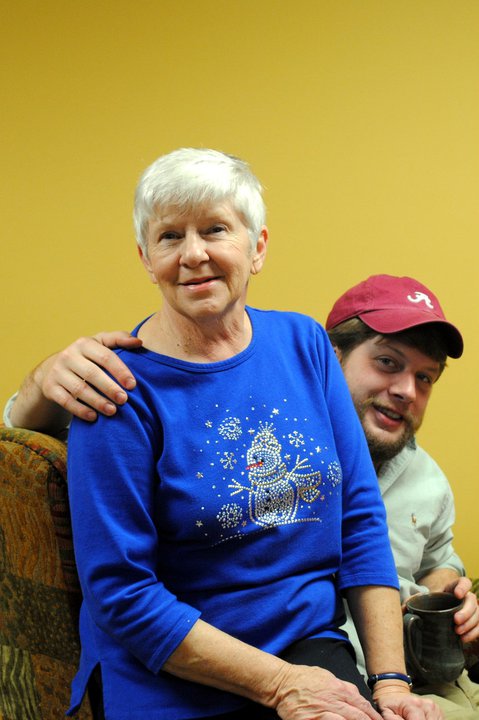 Family stories were shared like heirlooms; family pictures were preserved, treasured, passed on to be shared. My best inheritance came not after their deaths, but throughout their lives, in shoe boxes and grocery sacks. I have my great grandmother’s spinning wheel because my Mama Coats hid it in the barn for me so no one else would take it. The cornbread cooling on my kitchen counter right now was baked in Mama Cheatham’s little black skillet.
I learned how to be a good grandparent from my own parents too. They showed me that magical mathematics of love–it’s possible to love all thirteen grandchildren as completely as they loved the first one. With my children, they were the “young grandparents,” and yet now with great grandchildren, they still seem young.
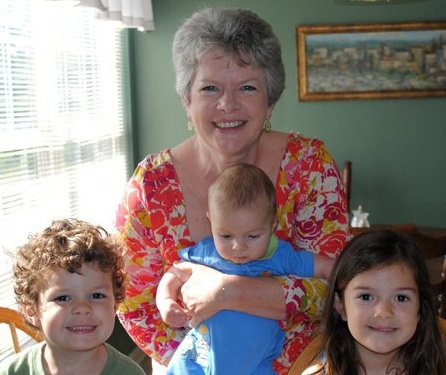
One of the nice things about our plan to live closer to my grandchildren is that I’ll be closer to my parents too. Who knows, they might still have a thing or two to teach me about our role!
Day 6: F is for Florence
I’ m the one who got away. I’ll admit it. I was born in Florence, Alabama, and lived most of my first forty years there before moving to North Carolina in 1995. Everywhere I go, though, I run into people from Florence. My friends have seen the phenomenon often enough that they tease me about it. I fly home from my first trip to Europe and find myself seated by a man who coaches at my high school–in Florence. I attend a regional English conference and discover that the woman sitting next to me not only grew up in Florence but was in my husband’s sixth grade class. In the middle of a cow pasture at a fiddler’s convention, I look up to see a former student edging her was down the row of seat toward me. Yep, she’s from Florence.
Alabama’s Renaissance City (yes, sister city to her namesake in Italy) has a lot going for her. I grew up in the sixties and seventies when the Muscle Shoals Sound came into its heyday, and we thought nothing of running into some of the top recording artists. Sam Phillips of Sun Record fame began in the music industry in Florence. Percy Sledge’s mega-hit “When a Man Loves a Woman,” was the first gold record out of FAME studio (Florence Alabama Music Enterprise, that it.) W. C. Handy, the Father of the Blues, was born in Florence, and for decades now, the city has celebrated his achievements with a great festival every year.

The music success is not just past history either. Nowadays, John Paul White one half of The Civil Wars, the Secret Sisters, and Patterson Hood of the Drive-by Truckers are Florentines. The Alabama Shakes are from just up Highway 72 in Athens.
One of the local celebrities these days is designer Billy Reid, who decided to put his flagship store right on Court Street. In the most recent issue of Garden and Gun magazine, he was quoted in a feature about “50 best things about the South.” His favorite was Odette’s, the restaurant that sits between his store and Coats Clothing Co., the haberdashery where one can find my father and my son most days. My mother tells me that she sells Odette’s eggs from her chickens. Six degrees of separation? I think not.
One of the strongest draws of the area is the access to water. The Tennessee River runs through town, widening out at Lake Wilson and with plenty of creeks and tributaries for fishing, swimming, and water skiing. In fact, my parents brought me home from the hospital to what we still call “the Little Red House,” right on Shoal Creek.

Florence has her shared of outlaws too. Jesse and Frank James came through town and robbed the payroll at one of the Locks in the county. My great grandmother always believed Frank had taken an alias and settled in Florence as an old man.
Less of a folk hero, though, was Mountain Tom Clark, an evil man reported to have killed babies on his bayonet and who bragged, “No one will ever run over me.” A judge with a wry sense of humor had his body placed not in the city cemetery but under the busiest main street through town in front of it. Now cars run over him all day every day. There’s a nice sense of justice in that.
I don’t get to Florence as often as I’d like to now–or as often as I should. After all, I still have both my parents, my older son, three sisters and their families and my husband’s siblings there, as well as my best friend (See D is for Debbie).
We aren’t likely to return there to live, but I’ll back often enough to gather talking points for all my Tar Heel friends who know to expect to hear my stories about Florence.

Day 5: E is for English Lit
As I am coming within the last days of my 25-year career in teaching, I can’t help feeling amused that English Lit has been my specialty area. You see, I skipped my high school senior year, so I didn’t have that experience myself. I went to college in the summer after eleventh grade, intending to return to high school in the fall and graduate with my class. After a little taste of the freedom of college, though, I didn’t relish the idea of returning. A little checking told me I could continue my college studies while working off the last two courses–Economics and Senior English–via correspondence course. I puttered away at the first course and at the end of my first year of college, with freshman comp complete and one sophomore lit, I decided to take off the summer, return home to work and take English IV with the summer school crowd that hadn’t passed on the first go around.
Needless to say, we didn’t read many of the classics. I don’t actually remember what we read, but it wasn’t Beowulf or Chaucer or anything by Shakespeare. I went back to college in the fall no wiser, but an official high school graduate at last. I finished two years later with an accounting degree.
My decision to teach English came a few years down the road, after I had children and realized that a teacher’s schedule would be perfect for a working mother. Even more important, I realized that I loved words so much more than numbers.
Returning to complete a master’s degree in English and education, I had the good fortune to study the classic trinity–Chaucer, Shakespeare, and Milton–under some of the most talented and engaging professors at the University of North Alabama. From my first year as teacher, I ended up most years with at least a couple of sections of senior English classes. Each year, we fought Grendel with Beowulf, learned to recite the first eighteen lines of Chaucer’s General Prologue in Middle English (perfect for this time of year), enjoyed the Arthurian romances (necessary for a true appreciation of Month Python), and–best of all–the Bard!
In high school, I had the time and luxury to have students out of their seats and on their feet for a readers’ theatre experience with Macbeth or Hamlet. Some of the toughest cases I taught mastered iambic pentameter well enough to use it when flirting.
Once I moved to the community college, I still opted for Brit Lit I when given the choice. Instead of excerpts, we got to read all of the classics–even Sir Gawain, which should never be read in parts, for risk of losing the sense of balance and mirroring of scenes.
I may not have made as many converts as I hoped, but each year, I hear from a student or two, letting me know that “it took.” At a concert recently, a former high school student whose name I couldn’t call stopped me to tell me that when she feels nervous, she still recites the General Prologue. “Tell your students it’s really worthwhile!” she insisted.
I could have told her I’d seen it for myself. When my daughter was giving birth to my first grandchild Avery nine years ago, the doctor on call, upon learning I taught English literature, mused, “Ah! Chaucer! Whan that Aprill with hit showers soote / the droughte of March had perced to the roote. . . ”
My daughter, already in the transitional phase, sat straight up in the hospital bed and continued: “and bathed every veine in swich licour. . . .”
What could have made a mother prouder?
Day 4: D is for Debbie
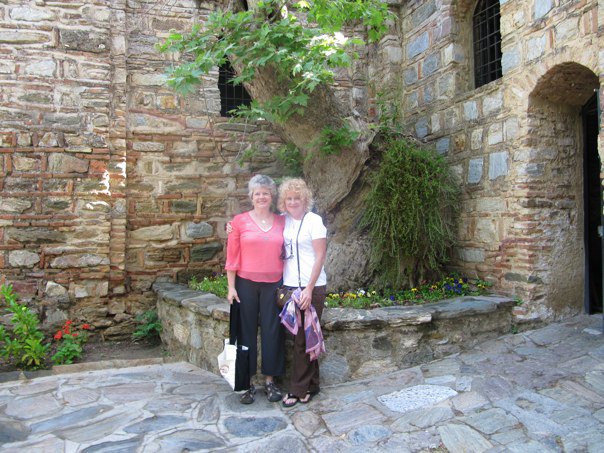
( Debbie (right) and me in Ephesus at the site believed to be the home of Mary the mother of Jesus, where she was taken to live by John the apostle.)
I’ve had the same best friend since I was about fourteen years old: That’s forty-four years, in case you’re wondering. Debbie and I met at church during junior high. At the time, we didn’t go to the same school, so we only saw each other on Sundays, Wednesday, and at youth group fellowships. In the tenth grade, though, my parents transferred me to her high school (after a little matter of dress code violation in the ninth).
Debbie is February to October older than me, so she got her driver’s license first. One little bit of trivia I recall is that her weight on her license was about 80 lbs. I wasn’t much bigger at the time. We often stood in front of the full-length mirror int he school bathroom, arguing over who had the skinniest legs.
My house and hers were not far apart, and in between lived Barry, the boy everybody wanted for a boyfriend. We rode back and forth, back and forth, past his house–until finally the two of them started dating. They stayed together fourteen years–then married other people.
Meanwhile, our friendship has endured. We are not alike at all. That may be part of the success of our friendship. On occasion, we’ve each confessed to the other, “I want to be you.” I took the traditional path–college and then marriage and children. She worked awhile before settling down. At her wedding, I had just delivered my third child and had to figure out how to breastfeed wearing a bridesmaid’s dress that buttoned down the back.
Debbie ended up adopting two daughters–girls I love like my own. The first was born in California. When Debbie and her family went to China to adopt the second daughter, I went along with them to help. That daughter graduates high school this year, but she still sometimes asks, “Didn’t I throw up on you in China?” or “Do you remember giving me a bath in the sink in China?”
Even though we’ve spent most of our adult lives in different states, with completely different interests, we have this bond we can’t even explain. We’ve never had a single fight. Never. We have laughed ourselves silly–often at others’ expense.
We have made lots of memories. She taught me how to drive a stick shift. We’ve sneaked out of the house together. We both delivered annoying impressions (You dirty rat! You killed my brother! or Judy, Judy, Judy…) in the wee hours of the morning at spend the night parties. We traveled to Istanbul together a few years ago, along with her two daughters. We’ve each made middle of the night phone calls when we needed each other despite the miles between us.
It may sound corny for a woman my age to talk about her “best friend,” but I’m grateful to have experienced the kind of friendship that comes along so rarely. Everybody needs a Debbie–but you can’t have mine.
 Alabama Tar Heel